The Power of the Proactive Investor, Part Two

In Part One of this post, we highlighted strategies that proactive investors can use to better protect their financial security.  The strategies mentioned in Part One were more oriented toward the investment account as a whole.

However, most securities claims involve allegations of unsuitability and/or breach of fiduciary duty regarding investment products and/or investment advisory services.  Given the number of investment options available to investors today, it is easy for an unscrupulous stockbroker or investment adviser to take advantage of an investor, especially an inexperienced investor.

The following strategies can be used by the proactive investors to avoid some of the more common complaints in securities claims.

1.  Choose appropriate classes of mutual fund shares to reduce expenses.  Fees and other expenses reduce an investor’s return.  Therefore, no-load mutual funds and/or exchange traded funds should generally be an investor’s first choice due to their reduced fee structure.

If an investor chooses not to use either no-load funds or exchange traded funds, A shares and B shares are the only type of mutual fund shares most investors should consider.  Many investors immediately lean toward B shares since they do not require the investor to pay front-end sales charges, or commissions.  B shares, however, may not be the best choice for the long-term investor due to the higher annual fees associated with B shares.

Generally speaking, A shares are often a better deal for a long-term investor due to the fact that annual fees for A shares are typically less than the annual fees charged by B shares.  If an investor has a large amount of money to invest, A shares often offer breakpoints to reduce any applicable sales charges.

Breakpoints are not generally offered on B shares.  B shares are often a better deal for short-term investors, since B shares do not impose a front-end sales charge.  While B shares generally carry higher annual fees and often impose deferred sales charges if an investor redeems the shares within a specified period of time, the holding period during which deferred sales charge are applicable is usually relatively short.

The investor’s ability to redeem B shares without penalty within a short period of time also allows the investor to minimize the effect of the higher annual fees of the B shares.  Some mutual fund companies offer to convert B shares into A shares after a certain period of time has elapsed.  Each investor must evaluate their own situation to determine the choice that is best for them.

Investors with managed accounts should always check to see whether their advisor is using A shares or B shares in the management of their account.  In most cases, it is generally agreed that advisors should only use A shares in managed accounts due to the lower annual fees charged by A shares and the fact that most mutual funds offer to waive sales charges for A shares held in managed accounts.

Another factor favoring the choice of A shares over B shares in managed accounts is the deferred sales charges on B shares.  Since managed accounts often involve frequent reallocations of the account’s assets, holding B shares in a managed account may ensure that the value of the investor’s account is reduced by the payment of deferred sales charges.

2.  Use breakpoints, when possible, to reduce the commissions on mutual fund purchases.  Most mutual fund companies offer investors a discount on front-end sales charges once an investor has invested a certain amount of money in their mutual funds.  Most mutual funds begin to offer such discounts once an investor has invested a cumulative total of $50,000 in their funds, with additional discounts for certain levels of additional investments.  Recommendations spreading investments among a multitude of asset classes may be cause for questioning, especially when large amounts of money are being invested and/or the recommended amounts are just below breakpoint levels.

3.  Get more than one opinion.  Medical patients are often advised to get a second opinion on major medical decisions.  Decisions affecting one’s financial security are equally important.  Unsuitable investment advice can drastically affect one’s life.  Unfortunately, some people holding themselves out as financial planners and investment advisors may be more interested in selling insurance and investment products than in the quality of the financial advice they are providing.

4.  Avoid the variable annuity trap.  Without question, variable annuities are one of the most over-hyped, most oversold, and least understood investment products.  A much publicized article in the Wall Street Journal reported that annuity salesmen at an annuity “boot camp” were instructed to treat potential annuity customers “like blind twelve-year olds,” and to tell customers that the annuities were “like credit cards.”

The NASD and the SEC are investigating various complaints regarding the sale of these investment products and have already imposed sanctions in some cases.  The high fees and expenses associated with variable annuities, along with their lack of liquidity and their negative tax aspects, make them an unwise investment choice for most investors.

Annuities can also have devastating effect on an investor’s estate plan, resulting in most of the investor’s money going to the company issuing the annuity rather than the investor’s heirs and loved ones.  For a more detailed analysis of variable annuities, click “Variable Annuities” on the navigation bar on our site.

5.  Don’t buy life insurance for investment purposes.  A popular mantra among insurance agents is that variable life insurance is the “Swiss army knife of financial planning.”  Anyone who hears such advice should look for another financial adviser.  If an investor needs life insurance, then they should buy life insurance that guarantees the amount of protection needed, which is the intended purpose of insurance.

Life insurance is neither intended for or appropriate for investment purposes.  The high fees and expenses associated with insurance are totally inconsistent with one of the basic tenets of investing, namely to minimize loss of principal so as to maximize the amount of money working for the investor.  While it is illegal for an insurance agent to misrepresent the nature of an insurance product, recent cases involving the alleged misrepresentation of life insurance as retirement/ investment programs demonstrate the need for investors to get advice from more than one investment advisor to better protect their interests.

6.  Beware of “black box” financial planning and portfolio recommendations.  Many financial advisers will offer to provide customers and potential customers with financial plans or asset allocation plans.  The price for such plans can range from free to thousands of dollars.

In most cases these are created with software programs based upon the input entered by the financial adviser.  While investors are warned that “past performance is no guarantee of future returns,” and we scoff at fortune tellers predicting the future, that is exactly what is generally used in creating such plans, historical returns or “guesstimates” of future returns, resulting in the familiar “garbage in, garbage out” scenario.

Furthermore, such software programs can be easily manipulated to produce whatever results are desired.  Most of the commercial software programs are based upon a financial theory known as Modern Portfolio Theory, which is known to have an inherent bias toward certain types of investments.

By manipulating the input data in favor of the preferred investments, certain results can be guaranteed.  This inherent instability of such computer programs has led one expert to refer to such programs as “error-estimation optimizers.”  For a more detailed analysis of “black box” financial advice, click “Faux Financial Planning” on the navigation bar on our site.

© 2011 InvestSense, LLC.  All rights reserved.

The information provided in this post is not designed or intended to provide legal, investment, or other professional advice since such advice always requires consideration of individual circumstances.  If legal, investment, or other professional assistance is needed, the services of an attorney or other professional advisor should be sought.

Posted in Asset Protection, Investment Portfolios, Investor Protection, Portfolio Construction, Retirement Plan Participants, Retirement Planning, Wealth Preservation | Tagged , , , , , , , , , , | 1 Comment

The Power of the Proactive Investor, Part One

“Your account is a brokerage account and not an advisory account. Our interests may not always be the same as yours. Please ask us questions to make sure you under-stand your rights and our obligations to you, including the extent of our obligations to disclose conflicts of interest and to act in your best interest. We are paid both by you and, sometimes, by people who compensate us based on what you buy. Therefore, our profits and our salesperson’s compensation, may vary by product and over time.”

The foregoing disclosure was part of a rule enacted by the Securities and Exchange Commission (“SEC”) in an effort to address an ongoing dispute about the disparity of standards for stockbrokers and investment advisers. The Financial Planning Association sued the SEC over the disparity and won, with the court striking down the rule and requiring that stockbrokers charging fees for investment advice register as an investment adviser.

The long-needed disclosure finally made the conflict of interests regarding stockbrokers very clear to investors. An SEC commissioned study by the Rand Corporation revealed that an alarmingly high percentage of investors mistakenly believed that it was stockbrokers, not investment advisers, who owed clients a fiduciary duty. A TD Ameritrade study resulted in similar findings. And yet the SEC did not require stockbrokers to continue to disclose the conflict of interests issue.

The recently passed Dodd-Franks Act included provisions which would allow the SEC to enact a universal fiduciary standard that would apply to anyone providing investment advice to the public. It is hard to see how anyone could legitimately argue against such a common sense requirement, as it furthers the express intent of the federal securities laws and the expressed purpose of the SEC, namely to protect investors. And yet Congress continues to stall and delay implementation of a universal fiduciary standard, even suggesting that yet another study should be done.

In an effort to help Congress and save taxpayers’ money, I conducted an informal survey of 210 people based on the following question – At the present time, investment advisers are required to always put a client’s interest first, but stockbrokers are allowed to put their own personal and financial interests ahead of their clients’ interests. Do you feel that anyone providing investment advice to the public should always be required to disclose any actual or potential conflicts of interest and always put their clients’ interest first? Of the 210 people polled, 100% answered in the affirmative, with many expressing surprise that this situation even existed. You are welcome Congress.

The SEC’s failure to continue to require the conflicts of interest disclosure for regular brokerage accounts highlights the need for investors to be proactive in managing their investment accounts. Not all stockbrokers are dishonest and not all investment advisers are honest. A healthy dose of skepticism never hurts. That being said, based upon my experience as a former compliance officer and a current CFP® professional, Accredited Wealth Management Professional™ and attorney, I offer the following proactive strategies.

1. Always keep copies of all forms and documents that are filled out and/or signed. Documents have been known to disappear or change when questions come up.

2. Never sign blank documents and leave it to someone else to fill the document in.

3. Never give anyone discretionary control over investment accounts. Abuse of discretion is one of the leading complaints regarding stockbrokers and investment advisors. The potential risks simply outweigh any alleged benefit. If an investor is asked to sign a trading authorization so that a brokerage firm can accept orders from the investor’s broker or advisor, the investor should write “NO DISCRETION” on the form to avoid any confusion as to the power being authorized.

4. Read all account statements and correspondence received from a brokerage firm, a broker or an advisor. If wrongdoing is going on in an account and is reflected in the account statements or correspondence, failure to promptly notify the brokerage firm and to object to such questionable activity may prevent an investor from recovering any losses resulting from such activity.

5. Ask questions. Ask why certain investments are being recommended. Ask whether a purchase of a recommended investment product would result in a commission for the broker or the advisor making the recommendation and, if so, what the amount of the commission would be. Ask whether the recommended investment product is a proprietary product of the company that the broker or the advisor is affiliated with and, if so, ask whether the broker or the advisor can recommend similar non-proprietary products. Ask whether the recommended product has ongoing fees and, if so, how much those fees are. Even if an investor is turning the management of their investment account over to a money manager, the investor should continually ask questions in order to protect against losses due to “black box” asset allocation.

6. Consider all aspects of an investment. Some investors only look at the historical or projected return of an investment before making an investment decision. Investors should always consider factors such as the risk/volatility of an investment, the fees associated with an investment, and the tax aspects of an investment. This is particularly true when considering the purchase of an annuity.

7. Be alert to brokers and advisors possibly “working their book.” When business is slow, brokers and advisors may be advised to “work their book.” This may explain unexpected phone calls suggesting that an investor review their investment portfolio and reallocate their assets, switch mutual funds to buy funds from a different fund family, or perform an annuity exchange.

It is illegal for a broker or an investment advisor to make investment recommendations for the purpose of generating commissions. Certain practices should raise red flags for investors. Recommendations that an investor sell funds of one mutual fund company and buy the same or similar type funds of another mutual fund company should be questioned. Recommendations that an investor sell funds of one mutual fund company and buy different types of funds from another mutual fund company should be questioned if the original mutual fund company offers the same or similar type funds as those being recommended, as most mutual fund companies allow an investor to make internal fund exchanges without incurring new commissions.

Recommendations that an investor exchange one annuity for another annuity should always be questioned since the exchange will result in new commissions for the broker or the advisor.

Recommending that an annuity owner exchange annuities is especially suspicious when the current annuity is still subject to surrender charges, as the client would lose money as a result of having to pay surrender charges for the exchange. An investor who becomes aware of such practices should promptly notify the appropriate regulatory organizations.

8. Don’t be lulled into a false sense of security by an advisor’s credentials or designations. The number of letters after an advisor’s name does not ensure the skill or the integrity of the advisor. The most widely respected and recognized designation in the financial planning industry is the CFP designation conferred by the CFP Board of Standards. The CFP designation signifies that an individual has a certain level of experience in financial planning, has completed an extensive examination, and has complied with continuing education requirements.

Always ask for both Parts I and II, and all schedules, especially Schedule F, of an investment advisor’s Form ADV. Take the time to read the material to find out about the planner’s background and qualifications. Although registered investment advisors are allowed to use a disclosure brochure instead of their Form ADV, insist on the investment advisor’s Form ADV. Many disclosure brochures are nothing more than glorified marketing brochures, while the Form ADV contains the information the investment advisor filed with regulatory officials. Also check the planner’s records at the NASD’s web site (www.nasdr.com).

© 2011 InvestSense, LLC. All rights reserved.

The information provided in this post is not designed or intended to provide legal, investment, or other professional advice since such advice always requires consideration of individual circumstances. If legal, investment, or other professional assistance is needed, the services of an attorney or other professional advisor should be sought.

Posted in Asset Protection, Investment Portfolios, Investor Protection, Portfolio Construction, Retirement Plan Participants, Retirement Planning, Wealth Preservation | Tagged , , , , , , , , , , ,

Street Smarts

Wall Street has a lot of colorful sayings.  Some of the sayings actually contain useful information for investors.  I often refer to some of my favorite Wall Street sayings during my presentations.  Interestingly enough, I often have people come up to me and tell me they remember and use the sayings in managing their investment accounts.

As an attorney as well as an investment adviser, my favorite Wall Street saying is “don’t confuse brains with a bull market.”  If more investors took heed of this warning, I believe that there would be far less unnecessary losses in investors’ accounts.   Studies have consistently shown that approximately 75% of stocks follow the overall trend of the stock market.  “A rising tide lifts all boats ” and “the trend is your friend” are two further acknowledgements of the studies’ findings.

Quite simply, it’s hard not to make money in a bull market.  As Sir John Templeton said, “financial genius is a rising stock market.”  The key for investors is to acknowledge the impact of the primary trend in the stock and not be lulled into a false of security during bull markets.

Along those same lines, Warren Buffett took the “rising tide” principle one step further, adding that “it’s only when the tide goes out that you learn who’s been swimming naked.”  “Swimming naked” in this regard refers to investors who fail to implement risk management strategies into their investment portfolios.  While many investors focus only on return, investment legends like Ben Graham, Harry Markowitz, William Sharpe and Charles Ellis have suggested that risk management is actually the secret to investment success.  As another Wall Street saying goes, “don’t tell me how much you made, tell me how much you were able to keep.”  There are any number of risk management strategies that investors can use to manage their investment risk, including hedging through the use option strategies and inverse index investments.

“Bulls make money, bears make money, pigs get slaughtered” is just an acknowledgement of the cyclical nature of  the market.  A buy and hold approach to investing simply ignores the cyclical nature of the stock market and ensures that “pigs” will suffer unnecessary losses during bear markets and then have to spend time catching up in the subsequent bull market.

Advocates of a buy and hold approach point to issues such as market timing and the “best days” to support market timing.  We’ve addressed these issues in earlier posts and articles.  There is nothing in the works of Ben Graham and Nobel laureates such as Dr. Markowitz and Dr. Sharpe that suggest the superiority of a buy and hold approach to investing.  In fact, each of these men, as well as numerous other leaders in the field of investment management, have stated that it is important that investors make changes in their portfolios as conditions in the economy and the market change.

As our tag line suggests, informed, proactive investors have the power to better protect their financial security.  All I know is that I’ll rely more on Nobel laureates and investment legends and act to preserve my financial security.  After all, “no one ever went broke taking profits.”

Posted in Asset Protection, Investment Portfolios, Investor Protection, Portfolio Construction, Uncategorized, Wealth Preservation | Tagged , , , , , , , , , , ,

Optimizing Your Retirement Plan’s Investment Options

One of the things that continues to amaze me are the number of cases we see where participants in a retirement plan have set up unsuitable portfolios in their retirement accounts, thereby exposing themselves to unnecessary investment risk.  When asked how they arrived at the portfolio’s allocation mix, they usually respond by saying that they followed one of the pie charts that they had been shown during an education meeting at their company or by the plan’s investment adviser.

In order to reduce their potential fiduciary liability exposure, many companies choose to adopt what is known as a 404(c) retirement plan.  Under a 404(c) plan, the individual participants in the plan generally make their own decisions on how to invest their money, choosing from among various investment options offered by the plan’s sponsor (their employer).

Most retirement plans offer the employees some form of investment education program, with such programs usually being provided by the entity offering the investments or by an independent third-party.  A common scenario is to present the employees with various computer generated asset allocation models, usually in the form of a multi-colored pie charts.  The employee is then given the task to choose the model investment allocation model that they feel most comfortable with.

In order to obtain the fiduciary protections offered by 404(c) plans, employers must meet certain requirements.  One such requirement is that they provide the plan participants with ”sufficient information to make an informed decision”  Unfortunately, the Department of Labor’s concept of “sufficient information” does not include crucial information that employees need to know in order to effectively create and monitor their retirement account portfolios.

Clients and followers of this blog know that I like to refer to the study by Schwab Institutional that concluded that 75% of the portfolios they studied were unsuitable for the investors involved, based on the investor’s financial situation or financial needs.  Based on my personal experience, the percentage of unsuitable portfolios is even higher than Schwab’s findings.  When we talk to employee groups about managing their retirement plans, we suggest three keys areas for them to address

The first issue we discuss is “pseudo” diversification.  The Department of Labor only requires that employers provided risk and return information to employees for the investment options offered by the company’s retirement plan.  At the same time, the Department advocates the use of modern portfolio theory in managing investment portfolios.

Modern portfolio theory suggests that in creating an investment portfolio, an investor factor in not only risk and return numbers, but also the correlation of returns of the investments being considered.  Modern portfolio theory argues that by factoring in the correlation of returns, an investor can reduce the overall volatility of a portfolio and archieve more consistent returns.

As we discuss in our article, “Right Kind, Right Reason Investing-Positioning Your Portfolio for Success,” over the past ten years there has been a definite trend of increasing correlations of returns among equity investments.  And yet, in most cases, equity based investment options are the primary investment options offered in 401(k) and 404(c) plans.

The employer’s failure to  provide employees with correlation of returns information on a plan’s investment options and the failure to provide some method of computing the correlation of returns on such options usually results in employee retirement portfolios that are “pseudo” diversified in the sense that they have several types of investments, but the portfolios are not “effectively” diversified since the investments chosen are often highly correlated, thereby failing to provide the employee with the needed downside protection against market downturns.

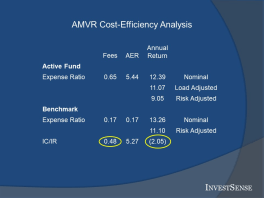
The second issue employees need to address involves “closet indexing” and inflated active expense ratio fees.  Studies have consistently found that actively managed mutual funds generally fail to outperform index mutual funds.  Nevertheless, most company retirement plans are made up primarily of actively managed mutual funds.  These actively managed funds carry significantly higher fees than comparable index funds, based on the premise that the investor benefits from the active management of the fund.

However, upon closer inspection, not only do most of the actively managed mutual funds consistently under-perform their comparable index fund, in many cases the actively managed fund owes most of its performance to the performance of the relevant benchmark index.  By looking at a fund’s R-squared ratio, an investor can see how much of a fund’s performance is traceable to the applicable benchmark index and how much of the fund’s performance is actually due to active management.  Fund’s with high R-squared ratings are typically referred to as “closet indexers,” since most of their performance is due to an index, not the fund’s managers.

Even more disturbing is the impact that such “closet indexing” has on the true, effective fees charged by actively managed funds.  Ross Miller of SUNY-Albany has created a measure, known as the active expense ratio, that allows investors to assess the impact of “closet indexing” on actively managed mutual fund fees.  The concept behind the active expense ratio is that if investors can achieve equivalent index fund returns at the lower fees charged by index funds, then the effective cost of the supposed active management increases disproportionately.  Miller’s studies have shown that the effective cost of actively managed ”closet indexer” mutual funds is often significantly higher than the fees stated in a fund’s prospectus, often five to six times higher.  Higher fees reduce the return to the investors.

The final issue employees need to address has to do with an employee’s overall investment approach.  In many cases employees are taught to adopt a buy-and-hold approach to investing, with occasional re-balancing back to the portfolio’s original asset allocation percentages.  This antiquated concept, based primarily on misconceptions or, in some cases deliberate misrepresentations, of the historic BHB study, needlessly cost American investors trillions of dollars during the bear markets of 200-2002 and 2008.

People have been led to believe that the BHB study found that most investment returns are based primarily upon asset allocation, not upon the specific investment chosen.  What the BHB study actually found was that asset allocation accounts for approximately 93.6% of the variability of a portfolio’s returns.  By looking at a portfolio’s allocation between stock, bonds and cash, the BHB study simply said that higher allocations to the riskier asset increased the variability of the portfolio’s overall returns.  Since stocks are historically riskier than bonds, and bonds are historically riskier than cash, the BHB’s findings are not that surprising.

However, the investment industry continually misrepresents the findings of the BHB study as evidence that buy-and-hold is the proper choice for portfolio management.  Buy-and hold ignores the cyclical nature of the stock market and exposes investors to unnecessary investment risk. Two of the pioneers of modern portfolio management, Nobel laureates Dr. Harry Markowitz and Dr. William Sharpe, have both emphasized the need for investors to make adjustments to their portfolios when the conditions in the stock market and/or the economy merit such actions.  Could the fact that stockbrokers and investment advisers often receive ongoing fees as long as their clients own an investment have anything to do with the promotion of the buy-and hold approach?

Putting the three steps together, in addition to looking for investments with favorable return and risk numbers, an employee’s goal should be to put together a retirement plan portfolio that consists of investments with low correlations of return and investments that are either low-cost index funds or funds that have a low R-squared rating.  Employees should then monitor their portfolio on a regular basis, no less than quarterly, and make adjustments to the actual investments or the allocation of the investments as needed in order to reduce their risk exposure.

The bottom line for investors in corporate retirement accounts is that they can, and should, take steps to obtain all of the information that they need to truly make an informed decision.  As the need for this additional information becomes more widely acknowledged in order for employees to be able to actually make the informed decisions contemplated under ERISA and to better protect their financial security, employers will hopefully realize the benefits of providing such information to employees and the potential liability issues for not doing so.

Posted in Asset Protection, Investment Portfolios, Investor Protection, Portfolio Construction, Retirement Plan Participants, Retirement Planning, Wealth Preservation | Tagged , , , , , , , , , , , | 2 Comments

The Absolute Truth About Wealth Preservation Investing

American investors lost trillions of dollars as a result of the bear markets of 2000-2002 and 2008.  As a result of such losses, mutual funds companies are beginning to offer so called absolute return mutual funds.  The goal of an absolute returns strategy is to achieve, positive, more consistent returns under all market conditions.  While the power of consistent returns has long been recognized, investors should be aware that the new absolute return funds often use different approaches in trying to achieve such results, some more questionable than others.

The focus on absolute returns has been long overdue.  While many investors and investment advisers focus primarily on returns, smart investors realize that the true secret to successful investing is managing investment risk.  Legendary investor Benjamin Graham first advanced this concept decades ago.  Investors would be well advised to read Charles Ellis’ classic, “Investment Policy-Winning the Loser’s Game” (the more recent edition simply goes under the title of “Winning the Loser’s Game”) for a simple explanation of the concept.  Simply put, the concept of absolute returns simply follows the Wall Street axiom of “don’t tell how much you made, tell how much you were able to keep.”

Many investors lost money in the recent bear markets because they adopted the popular static buy-and-hold approach to investing.  But the recent bear markets offered further proof that the buy-and-hold approach is fatally flawed in that it fails to recognize the cyclical nature of the stock market. What most investors do not realize is that the buy-and-hold approach is based largely on a famous study known as the BHB report and a misrepresentation of the study’s findings. 

Some financial advisors will mislead investors and tell them that that there is no reason to make adjustments in one’s portfolio since the BHB study found that asset allocation, not individual investments, accounted for 93.6% of investment returns.  What the BHB study actually found was that asset allocation accounted for 93.6% of the variability of investment returns, not the returns themselves, 

Looking at only three types of investments, stocks, bonds and cash, the BHB study concluded that the variability of a portfolio’s investment returns increased as more money was allocated to the more volatile investments.  In retrospect, this seems to simply be common sense.  The key takeaway for investors is that the BHB study, however, did not study the determinants of actual investment returns, did not claim to do so, and made no representations regarding same.

Advocates of the buy-and-hold approach to investing often offer numbers regarding the cost of missing the “best” days of the stock market.  As a trial attorney, I am always interested in the other side of the story, what is not being said.  In this case, what is not being said is that recent research indicates that the benefits of avoiding the “worst” days of the market far outweigh the cost of missing the “best” days of the market. 

A recent study by Javier Estrada of the IESE Business School found that missing the “best” 10, 20 and 100 days of the stock market (defined as the Dow Jones Industrial Average) during the period 1990-2006 reduced an investor’s returns by 38%, 56.8%% and 93.8%, respectively.  On the other hand, Estrada found that avoiding the “worst” 10, 20 and 100 days of the stock market improved an investor’s returns by 70.1%, 140.6% and 1,691%, respectively.  The study found similar results for the period 1900-2006.  The difference in the numbers is due in large part to the fact that investors have to earn more, sometimes significantly more, than they lost just to break even and the time spent in making up for such losses constitutes an opportunity cost for an investor.

So what does this mean for investors?  Does this mean that investors should engage in short-term market timing to avoid market corrections?  Not at all, as trying to time the short-term swings in the stock market would be both costly and virtually impossible.

Absolute return investing simply acknowledges the cyclical nature of the market and then takes advantage of such nature to maximize potential performance.  Those familiar with the classic book,“The Art of War,” will recognize this strategy of using the nature of things to one’s advantage as a cornerstone of General SunTzu’s strategies, but it is equally applicable to investing. 

The truth is that most investment portfolios fail to take advantage of the nature of the market, as they contain too many investments with a high correlation of returns, meaning that the investments react in like manner to market conditions and therefore fail to provide an investor with adequate protection against downside risk.  A 2007 study by Schwab Institutional reported that 75% of investor portfolios studied were inappropriate for the investor in light of the investor’s goals and/or financial situation.  This unfortunate situation is often due to the shortcomings of the commercial asset allocation/portfolio optimization software often used by financial planners and investment advisers.  These software issues and the unnecessary investment risks they create are addressed more fully in other articles on the InvestSense web site. 

Fortunately, investors wishing to implement an absolute returns strategy can do so on their own and save the costs and expenses involved with mutual funds.  There are a number of investment products currently on the market that can greatly simplify the process of constructing an absolute returns portfolio.  By heeding the advice of General Tzu and focusing on investment alternatives that have varying levels of correlation of returns and monitoring the stock market to determine when portfolio reallocations or substitutions may be appropriate, an investor can effectively manage investment risk and improve their potential for investment success.

Posted in Asset Protection, Investment Portfolios, Investor Protection, Portfolio Construction, Retirement Plan Participants, Retirement Planning, Wealth Preservation | Tagged , , , , , , , , , , , | 2 Comments

Breach of Trust

Once again, Congress has shown its true colors, as steps have been taken to prevent the implementation of a universal fiduciary standard in the financial services industry.  Despite the clear evidence of recent abuses on Wall Street and studies supporting the need for such a standard, Congress simply reinforces the points discussed in P.J. O’Rourke’s classic, “Parliament of Whores.”  Since both Republicans and Democrats suffered significant losses as a result of abusive practices in the financial services industry, Congress is clearly acting to protect the interests of the finanical services industry, stockbrokers and insurance salesmen, rather than the people. 

After all, what is so onerous or objectionable about making the financial services industry only recommend products and strategies that are in a client’s best interests?  And what do such protests really say about the industry and its current practices?  The finanical services industry has countered by saying they only want to preserve the public’s right to choose.  So let’s have a national poll  and ask the public whether they would rather have a law that requires a financial adviser to always put the client’s interests first, or a law that allows a financial adviser to put the adviser’s interests ahead of the client.  I’m not a betting man, but even I would lay some money down in Las Vegas on the outcome of that poll.

The public recently gained some much needed relief from the abuses of the securities arbitration process when the rule was changed to allow investors to choose a panel made up solely of public citizens.  While the ongoing denial of an investor’s right to the courts is troubling, at least the new rule prevents the past ruse of an objective arbitration panel, where in truth two of the three members of the panel had pro-industry ties or leanings. 

Most people are familiar with George Santayana’s famous quote, that “those who do not remember the past are condemned to repeat it.”  Congress obviously took nothing away from the bear markets of 2000-2002 and 2008.  The recent actions of Congress clearly indicate that it’s business as usual in Congress, with an ongoing breach of trust as the interests of the special interests groups are being put ahead of the welfare of the public.  The message of the 2010 elections has apparently already been forgotten.  The current attempt to block much needed protection for investors should be closely monitored, as it may be necessary to send another message in the 2012 elections to those who refuse to protect their constituents.

Posted in Asset Protection, Investor Protection, Portfolio Construction, portfolio planning, Portfolio Planning, Retirement Planning, Wealth Preservation

Hello world!

“InvestSense – the art of combining sound, proven investment techniques with common sense to provide investors with both upside potential and protection against downside risk.”

The goal of the “CommonSense InvestSense” blog is to provide investors with information that they can use to improve their investment success and to protect their financial security against unethical financial advisers and practices.

Posted in Wealth Preservation | Tagged , , , ,