Is Your 401(k) Plan Truly Acting in the Best Interests of the Plan Participants?: Evaluating Your 401(k) Plan with the Active Management Value Ratio and Fiduciary Prudence Forensics

James W. Watkins, III, J.D., CFP EmeritusTM, AWMA®

Most pension plans use mutual funds as the primary investment options within their plan. The Restatement of Trusts (Restatement) states that fiduciaries should carefully compare the costs and risks associated with a fund, especially when considering funds with similar objectives and performance.1 The Restatement advises plan fiduciaries that in deciding between funds that are similar except for their costs and risks, the fiduciary should only choose the fund with the higher costs if the fund “can reasonably be expected” to provide a commensurate return for such additional costs and/or fees.2

Given the historical underperformance of many actively managed mutual funds, factoring in commensurate returns can be a significant hurdle that pension plan fiduciaries too often fail to properly consider. A fund with higher costs that fails to provide a commensurate return to a plan participant, namely a higher positive incremental return than the fund’s incremental costs, has no inherent value to an investor and is clearly imprudent.

A common argument by the financial services industry, and even some courts, is that a fiduciary is not legally bound to select the least expensive investment option. However, that argument, focusing only on costs, can be misleading, as other factors must be considered. TIAA-CREF properly summed up a plan sponsor’s fiduciary obligations with regard to factoring in an investment’s costs, stating that

[p]lan sponsors are required to look beyond fees and determine whether the plan is receiving value for the fees paid. This should include an evaluation of vital plan outcomes, such as retirement readiness, based on their organization’s values and priorities.3

So, how does one determine whether a plan is “receiving value,” an actual benefit from a plan adviser’s advice? Businesses often use a simple and straightforward cost/benefit analysis to determine whether to pursue a project based on the cost-efficiency of the project. When a cost/benefit analysis indicates that the projected costs exceed the projected benefits, the project is usually deemed cost-inefficient and is not worth pursuing.
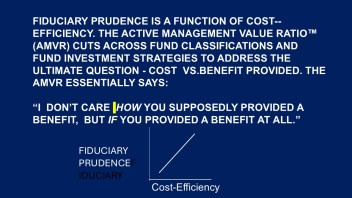
A simple cost/benefit analysis would seem to be a natural part of a prudent process for plan sponsors to use evaluating the fiduciary prudence of investment products in defined contribution plans (DCPs). However, based on the evidence, very few plans seem to use cost/benefit analyses as part of their fiduciary prudence process. Furthermore, even when plans do use cost/benefit analysis, there are often legitimate questions as to whether such analyses were properly conducted.

An obvious question would be why some plans not use cost/benefit analyses in conducting their legally required independent and objective investigation and evaluation of investment options for their plan. Costs that exceed benefits would seem to be a simple enough standard.

Perhaps the answer lies in the fact that actively managed mutual funds continue to compose the majority of investment options within current defined contribution plans. Studies have consistently shown that the overwhelming majority of actively managed mutual funds are cost-inefficient, as they fail to even cover their costs.

99% of actively managed funds do not beat their index fund alternatives over the long term net of fees.4

Increasing numbers of clients will realize that in toe-to-toe competition versus near–equal competitors, most active managers will not and cannot recover the costs and fees they charge.5

[T]here is strong evidence that the vast majority of active managers are unable to produce excess returns that cover their costs.6

[T]he investment costs of expense ratios, transaction costs and load fees all have a direct, negative impact on performance….[The study’s findings] suggest that mutual funds, on average, do not recoup their investment costs through higher returns.7  

The Active Management Value RatioTM
Research has consistently shown that most people are more visually oriented when it comes to understanding and retaining information. Therefore, as a plaintiff’s attorney, I created a simply metric, the Active Management Value Ratio™ (AMVR) to provide a visual representation of the academic studies’ findings with regard to the performance of actively managed mutual funds, most notably the research of investment icons, including Nobel laureate Dr. William F. Sharpe, Charles D. Ellis, and Burton L. Malkiel.

[T]he best way to measure a manager’s performance is to compare his or her return with that of a comparable passive alternative.8

So, the incremental fees for an actively managed mutual fund relative to its incremental returns should always be compared to the fees for a comparable index fund relative to its returns. When you do this, you’ll quickly see that that the incremental fees for active management are really, really high—on average, over 100% of incremental returns.9

Past performance is not helpful in predicting future returns. The two variables that do the best job in predicting future performance [of mutual funds] are expense ratios and turnover.10

The beauty of the AMVR is its simplicity. In interpreting a fund’s AMVR scores, an attorney, fiduciary or investor only must answer two simple questions:

1. Does the actively managed mutual fund produce a positive incremental return?
2. If so, does the fund’s incremental return exceed its incremental costs?

If the answer to either of these questions is “no,” then the fund does not qualify as cost-efficient under the Restatement’s guidelines.
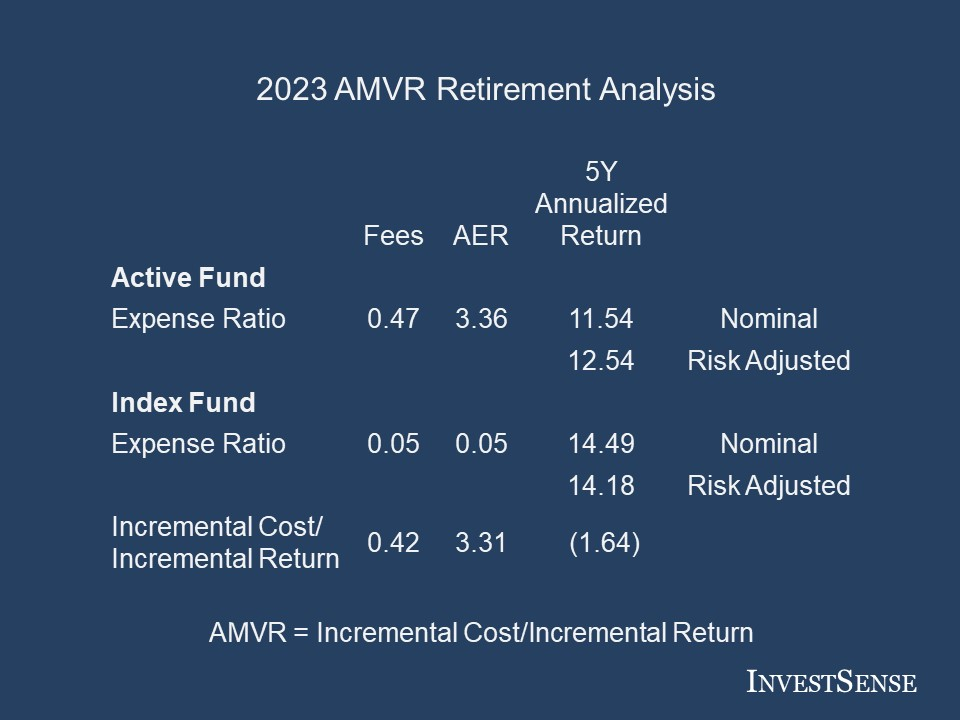

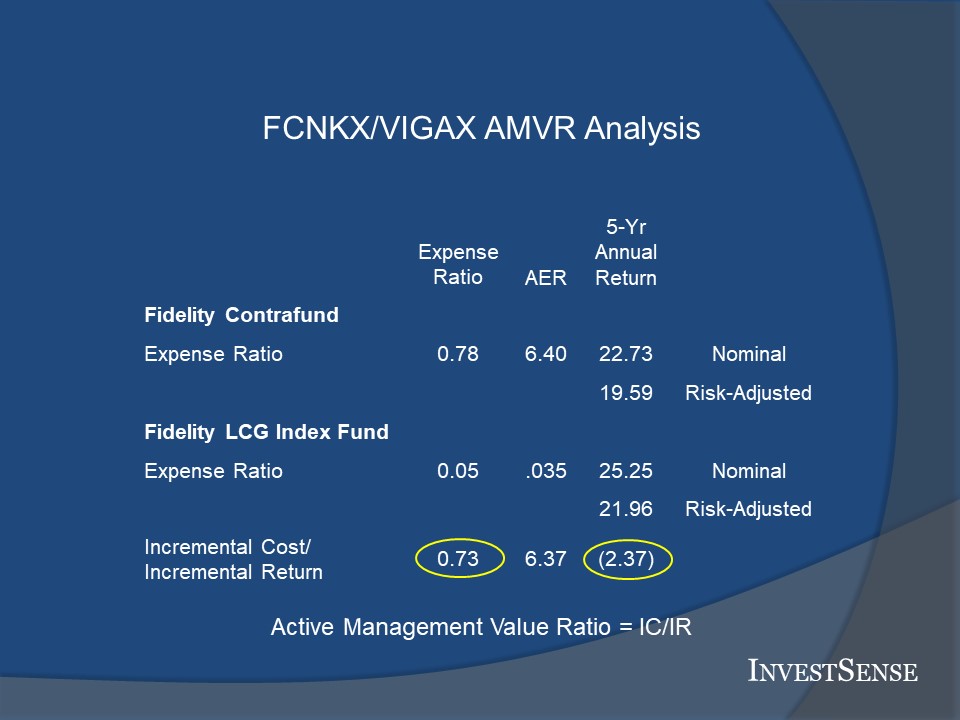
The AMVR slide shown above is a cost/benefit analysis comparing the retirement shares of two popular large cap growth mutual funds, one an actively managed fund, the other an index fund.

A simple analysis shows that the actively managed fund’s incremental costs exceed the fund’s incremental negative returns. Since costs exceed returns, this would result in the actively managed fund being cost-inefficient relative to the index fund for the time period studied.

The Securities and Exchange Commission and the General Accountability Office have both found that each additional 1 percent in costs/fees reduces an investor’s end-return by approximately 17 percent over a twenty year period.11 If we treat the incremental underperformance of the actively managed fund as an opportunity cost, and combine that number with the incremental costs, based on the fund’s stated expense ratio, the projected loss in end-return inour example would be approximately 35 percent over a twenty year period

But does the nominal/stated cost version of the AMVR actually reflect the costs incurred by plan participants if the actively managed fund is selected within a plan?

The Active Expense RatioTM
In a 2007 speech, then SEC General Counsel, Brian G. Cartwright, asked his audience to think of an investment in an actively managed mutual fund as a combination of two investments: a position in an “virtual” index fund designed to track the S&P 500 at a very low cost, and a position in a “virtual” hedge fund, taking long and short positions in various stocks. Added, together, the two virtual funds would yield the mutual fund’s combined costs

The presence of the virtual hedge fund is, of course, why you chose active management. If there were zero holdings in the virtual hedge fund-no overweightings or underweightings-then you would have only an index fund. Indications from the academic literature suggest in many cases the virtual hedge fund is far smaller than the virtual index fund. Which means…investors in some of these … are paying the costs of active management but getting instead something that looks a lot like an overpriced index fund. So don’t we need to be asking how to provide investors who choose active management with the information they need, in a form they can use, to determine whether or not they’re getting the desired bang for their buck?12

Fortunately, Ross Miller introduced a metric, the Active Expense Ratio (AER), which, when combined with the AMVR, allows fiduciaries and investors to perform the type of analysis Cartwright suggested. Miller explains the importance of the AER as follows:

Mutual funds appear to provide investment services for relatively low fees because they bundle passive and active funds management together in a way that understates the true cost of active management. In particular, funds engaging in ‘closet’ or ‘shadow’ indexing charge their investors for active management while providing them with little more than an indexed investment. Even the average mutual fund, which ostensibly provides only active management, will have over 90% of the variance in its returns explained by its benchmark index.13

In the AMVR example shown, using nothing more than just the actively managed fund’s r-squared number and its incremental cost, the AER estimates the actively managed fund’s implicit expense ratio to be 3.36, resulting in an incremental correlation-adjusted expense ratio/costs of 3.31. Combined with the actively managed fund’s underperformance, and using the DOL’s and GAO’s findings, that would result in a projected loss of approximately 84 percent over a twenty year period.

The Fiduciary Prudence Score™
The AMVR provides all of the information needed to perform several types of cost/benefit analysis. The AMVR equation, incremental correlation-adjusted costs divided by incremental risk-adjusted return, provides an analysis of the premium paid by anyone investing in the actively managed mutual fund, relative to an investment in the benchmark index fund.

While the AMVR is simple enough, some have suggested that a more traditional metric focusing on return relative to costs would be more helpful and easier to understand. For some, the issue with the AMVR format seems to be that funds that do not produce a positive incremental return are not eligible for an AMVR rating due to their failure to produce a positive incremental return for an investor.

The AMVR metric makes it easy to produce a more return-focused cost/benefit analysis by flipping the original equation so that the incremental risk-adjusted return becomes the numerator and the incremental risk-adjusted costs becomes the denominator. This new metric is known as the Fiduciary Prudence Score™ (FPS).

In using the FPS, the goal is a ratio above 1.00, which would indicate that the actively managed fund’s incremental risk-adjusted return was greater than the fund’s incremental costs. The higher the fund’s FPS, the greater the value provided.

In the AMVR example shown above, the actively managed fund’s FPS would be zero due to the fund’s failure to provide a positive incremental risk-adjusted return. The zero score would indicate that the fund would be imprudent under the Restatement (Third) of Trust’s fiduciary prudence standards.

Some people have indicated an aversion to working with decimal points. In that case, simply multiply the FPS discussed above by 100 to get the more common 1-100 format. Anyone deciding to use the 1-100 format must keep in mind that the FPS score produced is a relative score, not an absolute score. In interpreting the FPS using the 1-100 format, a score above 100 would be needed to establish that the actively managed fund provided value, provided incremental risk-adjusted returns that were greater than the fund’s correlation-adjusted incremental costs.

While other benchmarks could obviously be tested, using either form of incremental costs as the numerator, the cost-consciousness/cost-efficiency requirements of the Restatement would also have to be considered.

Annuities and Breakeven Analysis

“I’m not so much concerned about the return ON my money as I am the return OF my money. – Mark Twain

The post, “Annuities Are the Antithesis of Fiduciary Prudence,” was primarily the result of an AI search on Stanford University’s excellent new AI platform, STORM. One of the interesting features of STORM is its “BrainSTORMing” feature, short analyses on specific aspects of the subjects of the AI search. Another useful aspect of STORM is its liberal supply of footnotes, which allow for greater in-depth analysis on the topic. I have found the STORM platform very useful and accurate, which is why I decided to highlight the platform in a post

The report itself was originally published on our sister site, “The Prudent Investment Fiduciary Rules.” (fiduciaryinvestsense.com) As for the report itself, note that the breakeven analysis shows that the odds are heavily against the annuity owner ever breaking even, from ever recovering 100% of their original investment, resulting in the annuity issuer receiving most of the original investment, not the owner or the owner’s heirs. This is the reason why estate planning attorneys often refer to lifetime income annuities as estate planning “saboteurs. ” as such annuities typically deplete the estate of the assets necessary to implement the annuity owner’s estate plan and final wishes.

This is why InvestSense always recommends that plan sponsors insist that anyone recommending anyone investment for a 401(k) plan support such recommendations with a written forensic analysis before including the asset in a plan, an AMVR analysis for mutual funds and a properly prepared breakeven analysis for annuities, an analysis that factors in both present value and mortality risk. Fair warning – The party making the recommendations will typically refuse to provide such analyses, as they know the true value of their advice. They just do want a client to know. Such supporting analyses may also help demonstrate the due diligence measures that the plan used in selecting a plan’s investment options.

Going Forward

[A plan sponsor’s fiduciary duties are] “the highest known to the law.”14

In reviewing some recent court decisions involving defined contribution plan (DCP) litigation alleging a fiduciary breach, some courts have seemingly lost sight of ERISA’s defined goal, that being to protect workers and to help them prepare for retirement. Some courts rarely address the issue of whether the DCP’s investment options produce value for plan participants. As mentioned earlier, a prudent DCP investment option is one that is cost efficient, one whose benefits are at least commensurate with the fund’s extra cost and risks.

The problem for many DCP plan sponsors and other DCP fiduciaries is the history of consistent underperformance by many actively managed mutual funds relative to passively managed index funds. The FPS could reduce the time and costs of performing the legally required independent investigation and evaluation of each investment option chosen for a plan.

The simplicity of both the AMVR and the FPR should improve the quality of investments chosen for a DCP plan, thereby reducing the risk of litigation and unwanted fiduciary liability exposure. The combination of the AMVR and the FPS could easily expose situations where the plan adviser is not providing value for the plan or its participants, in which case a prudent plan sponsor should consider replacing the plan provider in order to reduce any potential future fiduciary liability exposure.

By combining the AMVR and the FPS, DCP plan sponsors should be able to use “humble arithmetic” to easily create and maintain win-win DCP plans that provides value for both the plan sponsor, the plan participants, and their beneficiaries.

The other motivation behind this post is to reinforce the advice we provide to all of our fiduciary risk management clients – that being to always include in all plan advisory contracts that the plan adviser must always provide written fiduciary prudence analyses to support each recommendation provided by a the adviser. Such a requirement not only establishes the due diligence of both the plan sponsor and the plan adviser, but can also serve as evidence in cases where litigation becomes necessary. Plan advisers are typically well paid. If questions arise regarding the reasonableness of such compensation, such forensic analyses can serve to try to justify such additional costs.

Notes
1. Restatement (Third ) Trusts §90 cmt m. Copyright American Law Institute. All rights reserved.
2. Restatement (Third) Trusts §90 cmt h(2). Copyright American Law Institute. All rights reserved.
3. TIAA-CREF, “Assessing the Reasonableness of 403(b) Fees,” https://www.tiaa.org/public/pdf/performance/ReasonablenessoffeesWP_Final.pdf.
4. Laurent Barras, Olivier Scaillet and Russ Wermers, False Discoveries in Mutual Fund Performance: Measuring Luck in Estimated Alphas, 65 J. FINANCE 179, 181 (2010).
5. Charles D. Ellis, The Death of Active Investing, Financial Times, January 20, 2017, available online at https://www.ft.com/content/6b2d5490-d9bb-11e6-944b-eb37a6aa8e. 
6. Philip Meyer-Braun, Mutual Fund Performance Through a Five-Factor Lens, Dimensional Fund Advisors, L.P., August 2016.
7. Mark Carhart, On Persistence in Mutual Fund Performance,  52 J. FINANCE, 52, 57-8 (1997).
8. William F. Sharpe, “The Arithmetic of Active Investing,” available online at https://web.stanford.edu/~wfsharpe/art/active/active.htm.
9. Charles D. Ellis, “Letter to the Grandkids: 12 Essential Investing Guidelines,” https://www.forbes.com/sites/investor/2014/03/13/letter-to-the-grandkids-12-essential-investing-guidelines/#cd420613736c
10. Burton G. Malkiel, “A Random Walk Down Wall Street,” 11th Ed., (W.W. Norton & Co., 2016), 460.
11. Pension and Welfare Benefits Administration, “Study of 401(k) Plan Fees and Expenses,” (DOL Study) http://www.DepartmentofLabor.gov/ebsa/pdf; “Private Pensions: Changes Needed to Provide 401(k) Plan Participants and the Department of Labor Better Information on Fees,” (GAO Study).
12. SEC Speech: The Future of Securities Regulation: Philadelphia, Pennsylvania: October 24, 2007 (Brian G. Cartwright). http://www.sec.gov/news/speech/2007/spch102407bgc.htm
13. Ross Miller, “Evaluating the True Cost of Active Management by Mutual Funds,” Journal of Investment Management, Vol. 5, No. 1, 29-49 (2007) https://papers.ssrn.com/sol3/papers.cfm?abstract_id=746926.
14. Restatement of Trusts 2d § 2, comment b (1959). ” Donovan v. Bierwirth, 680 F.2d 263, 272 n.8 (2d Cir. 1982)

Copyright InvestSense, LLC 2025. All rights reserved.

This article is for informational purposes only, and is neither designed nor intended to provide legal, investment, or other professional advice since such advice always requires consideration of individual circumstances.  If legal, investment, or other professional assistance is needed, the services of an attorney or other professional advisor should be sought.

lknolknokn;p

Posted in 401k, Active Management Value Ratio, AMVR, annuities, Consumer Protection, cost efficient investing, cost-effficiency, defined contribution plans, ERISA, Fiduciary, fiduciary prudence, fiduciary responsibility, Fiduciary Standard, Investment Advisors, Investment Portfolios, investments, Investor Protection, pension plans, plan sponsor, Retirement, Retirement Plan Participants, Retirement Planning, retirement readiness, Uncategorized, Wealth Accumulation, Wealth Distribution, Wealth Management, Wealth Preservation | Tagged , , , , , , , , , , , | Leave a comment

InvestSense 101: Assets Under Management…or Mismanagement? – Separating Fact From Fiction

James W. Watkins, III, J.D., CFP Board Emeritus™, AWMA®
 
The other day I noticed yet another publication announcing their list of top investment advisors.  I always enjoy reviewing such lists, not so much for who is on the list, but rather for who is not on the list.  Amazingly, the names of respected investment advisors are often missing from such lists. 

Unfortunately, the public is not aware of such concerns or other alleged issues involved in compiling such lists.  In many cases, the primary criterion or, in some cases, the only criterion used in evaluating an investment advisor for inclusion on the list is the advisor’s alleged amount of assets under management (“AUM”). 

I have never understood the media’s preoccupation with AUM and the presumed correlation between AUM and an investment advisor’s asset management skills.  As a securities/ERISA attorney and former securities compliance director, I can assure investors that there is no proven correlation between an investment advisor’s claimed AUM and an investment advisor’s asset management skills. 

In analyzing AUM, certain questions need to be considered.  When AUM numbers increase, how much of the increase is due to the return on existing AUM and how much of the increase is simply due to the inflow of new money?  Growth in AUM from the inflow of new money might be an indicator of an investment advisor’s marketing skills, but not necessarily their asset management skills. 

Have the AUM numbers been independently verified?  There have been a number of regulatory enforcement actions for misrepresentations of AUM.  Who actually manages the AUM?  If actual management of an advisor’s AUM is turned over to a third party asset manager, who is protecting the clients’ interests and what impact do the extra fees have on investment returns?

“Assets under management” implies that investors receive comprehensive and continuous asset management.  Anyone providing such services is required to be personally registered as an investment advisor or to be affiliated with a registered investment advisory firm.  

Investment advisors are, by law, fiduciaries.  Fiduciaries are held to an extremely high standard of care in their dealings with clients.  A fiduciary’s duties include:

  • A duty of loyalty, a duty to always put a client’s interests first
  • A duty to disclose any actual or potential conflicts of interest
  • A duty to control fees and other costs in managing a client’s account
  • A duty to manage accounts prudently

The “Value Added” Equation
Management consultants often refer to the concept of distinguishing one’s business by providing “value added” services to clients.  In the context of asset management, a client should ask what the investment advisor does in managing the client’s assets that truly creates value for the client and distinguishes themselves from other investment advisors.

A popular Wall Street saying is that “a rising tide lifts all boats.”  Studies and experience have shown that, generally speaking, at least two-thirds of all stocks rise during a bull market.  Therefore, while mutual funds and investment advisors may tout their performance during a bull market, the truth is that it is difficult not to make money during a bull market.

Another issue with regard to the value added question is the amount of fees charged for such services. While many investment advisers charge a stated fee of 1 percent of assets under management, it can be argued that the effective fee is significantly higher. Some industry experts have suggested that fees should be evaluated in terms of the benefit received since the adviser has nothing to to do with the customer’s pre-existing assets.1 By evaluating fees in terms of the benefit provided by an adviser, customers can get a more meaningful analysis of the value added proposition of their adviser.

Active Management/Passive Management Debate
So, experience and history establish that it is relatively easy to make money during a bull market.  Investment advisors may counter with the argument that the “value added” service that they provide is helping clients choose the “right” investments.  But do they?

Many investment advisors recommend that their clients purchase actively managed mutual funds that impose expensive loads and/or high annual fees, even though studies have consistently shown that most actively managed funds consistently underperform less expensive and passively managed index funds.  Furthermore, the value provided by actively managed funds is questionable, as a number of these funds have been shown to be “closet indexers,” funds whose performance can be largely explained by the performance of passive investment management rather than the contributions of active investment management. 

Investors can determine to what extent a mutual fund is a “closet indexer” by checking the fund’s R-squared rating.  R-squared is a statistical measure that reflects the percentage of a mutual fund’s performance that can be attributed to the movement of the relevant benchmark index rather than the contributions of active management.  R-squared scores range from zero to one.  The higher the R-squared rating is, the higher the fund’s “closet indexer” qualities.  An R-squared rating of 0.95 and above is generally considered to be indicative of “closet indexing,” although some consider an R-squared rating of 0.80 and above to be significant.

“Closet indexing” by actively managed mutual funds raises questions regarding the true costs incurred by investors in the fund and the reasonableness of such costs.  Since investors can easily purchase passively managed no-load index funds that assess low annual expenses, the relative cost of active management may be higher than the fund’s quoted annual expense ratio.

Professor Ross Miller of the State University of New York addresses this issue in his paper, “Measuring the True Cost of Active Management by Mutual Funds.”2 Professor Miller has developed a formula, known as the “active expense ratio,” to determine the true cost of actively managed mutual funds.  By using a fund’s R-squared rating to represent the percentage of passive management in the fund, and then comparing the annual expense ratios of available index funds to the quoted annual expense ratio of the actively managed fund, Professor Miller calculates the true cost of the active management provided by the fund.

For example, consider an actively managed mutual fund that has an R-squared rating of 0.90 and a quoted annual expense ratio of 1 percent.  The high R-squared rating indicates that approximately 90% of the fund’s performance can be attributed to factors other than the fund manager’s active management skills. 

Assume that the actively managed fund has a five-year annualized risk adjusted return of 12 percent, while a comparable index fund has an five year annualized return of 11 percent and a stated expense ratio of 0.20 percent. Using the AER metric, the implicit expense ratio would be 4.50 percent, over 300 percent higher than the active fund’s stated expense ratio.

While Professor Miller’s process is much more complex than this simple example, his general findings are that the effective true cost of active management is often significantly higher than the actively managed fund’s quoted annual expense ratio.  Professor Miller provides numerous examples of actively managed funds whose effective true cost is 400-500 percent, in some cases even higher, than the fund’s quoted annual expense ratio, including some of the largest and most popular mutual funds 

Consequently, an investment advisor’s claim that the “value added” service they provide is assistance in choosing the “right” investments may not be accurate if they recommend actively managed mutual funds to their clients.  Recent revelations that some investment advisors may be recommending mutual funds to clients based upon the investment advisor’s revenue sharing arrangements with a mutual fund, rather than a client’s best interests, also cast doubt on the “value added” aspect of such recommendations.        

If an investment advisor is causing a client to incur unnecessary costs by recommending expensive, actively managed “closet index” mutual funds instead of less expensive index funds with a similar performance record, legal and ethical issues may arise regarding the investment advisor’s fiduciary duty to put a client’s interests first and to control and reduce investment costs.  Legal and ethical issues may also arise if an investment advisor is “double dipping,” charging a client both an asset management fee and receiving commissions for product sales and purchases involving the client’s asset management account. 

The True Value of an Investment Advisor
If it is hard not to make money in a bull market, and if inexpensive, passively managed index mutual funds generally outperform fee-laden actively managed mutual funds, what value, if any, does an investment advisor contribute to asset management?

Remember the Wall Street saying that “a rising tide lifts all boats?”  Warren Buffett goes one step further, adding that “a rising tide lifts all boats, and when the tide goes out, everyone finds out who has been swimming naked.”

In the context of asset management, “swimming naked” is equivalent to managing assets without having an effective risk management program in place.  Investors often get so caught up in returns that they fail to protect against downside risk.  Bull markets become bear markets and vice versa.  The bear market of 2000-2002 and 2008 taught many investors about the value of an effective risk management plan. 

Enter the investment advisor.  Forget the claimed amount of assets under “management,” the fancy titles, the company plaques and trophies, and the fancy marketing materials.  Look at your investment advisor’s performance record and determine how effective your investment advisor has been at avoiding significant losses in your investment portfolio.  What, if any, risk management strategies has your investment advisor discussed with you and actually implemented?  Are you possibly a victim of the Wall Street “the firm made money, the broker made money, two out of three ain’t bad” trap?

Money for Nothing?
Some investment advisors believe that the only risk management program needed is an occasional re-balancing of the investor’s portfolio to restore the original asset allocation percentages.  Investment advisors who advocate this type of static approach dismiss any sort of active asset re-allocation, either as to the type of asset classes used or to the allocation percentages, as “market timing.”  These investment advisors maintain that market timing does not work and that the cost of missing even a relatively few “best” days of the market can be significant.

This type of static asset allocation strategy raises several issues.  First, it presumes that the original asset allocation was appropriate.  The asset allocation software used by most investment advisors is based upon a process known as means-variance optimization (“MVO”).  Experience has shown that MVO-based software can be unstable, resulting in asset allocation recommendations that are counterproductive. 

The instability of MVO-based software is due to questions regarding the reliability of the input data used in the software program and the inherent bias in the calculation process used by such software.  This “black box” approach to asset allocation totally ignores (1) the dynamic nature of the stock market and the economy, and (2) the fact that the risk, return and correlation numbers typically used in asset allocation computer programs are not static, but are constantly changing. The cumulative effect of these shortcomings has led one noted critic of MVO-based asset allocation software to label such software as “error-maximization optimizers.”3 

Most asset allocation/portfolio optimization software is based on the work of Dr. Harry M. Markowitz and/or Dr. William F. Sharpe, Nobel laureates for their work in the area of asset management.  Interestingly, neither Dr. Markowitz’s nor Dr. Sharpe’s work advocates a static approach to asset allocation.  In fact, Dr. Sharpe has criticized some of the current practices in asset allocation as “financial planning in fantasyland”4 and has emphasized the need for flexibility in asset management in order to respond effectively to changes in the stock market and/or the economy.5

Another issue regarding the quality of computerized asset allocation has to do with the fact that certain asset classes may not be available in the asset allocation software, including asset classes that historically have performed better when markets are in a downward trend.  In many cases, the asset classes in asset allocation software programs are primarily growth oriented, with few or no alternative asset classes available to use to hedge the investor’s portfolio against downside investment risk. 

In most cases, the absence of such alternative and hedge asset classes is blamed on the difficulty in determining the appropriate risk and return input data to use for such assets.  Whatever the reason, the absence of such alternative and hedge asset classes taints the computerized asset allocation recommendations, potentially leaving an investor exposed to unnecessary investment risk due to an over-concentration in growth oriented assets classes. 

The characterization of defensive risk management strategies as market timing is misleading.  The classical definition of market timing refers to the short-term movement of assets to being either 100% in the market or 100% out of the market, with no middle ground. 

However, an effective risk management program does not require such a radical “all or nothing” approach.  The goal of risk management is not to call the exact short-term turning points in the stock market in an attempt to maximize investment gains.  The odds of successfully using such an approach on a consistent basis, as well as the costs that would be involved, would be overwhelming. 

The goal of risk management should be to re-allocate assets defensively in the face of intermediate or long-term indications of deterioration within the stock market and/or the economy in order to preserve an investor’s investment capital.  In most cases, the defensive re-allocation would take place on a gradual basis based on developments in the stock market and/or the economy.  The value of such a risk management approach has been validated by a recent study that shows that avoiding significant losses in the stock market has a far greater impact on an investor’s long-term total returns than the impact of possibly missing a few of the stock market’s “best” days.

In “Black Swans, Market Timing and the Dow,” Professor Javier Estrada of the IESE Business School states that over the period 1900-2006, missing the best 10, 20 and 100 days on the Dow Jones Industrial Average Index (“DJIA”) would have reduced an investor’s terminal wealth by 65%, 83.2% and 99.7% respectively.6 Conversely, avoiding the 10, 20 and 100 worst days on the DJIA over the same time period would have increased an investor’s terminal wealth by 206%, 531.5% and 43,396.8% respectively. 

Professor Estrada also performed a similar best days/worst days analysis on the DJIA for the period 1990-2006, finding that missing the best 10, 20 and 100 days on the DJIA would have reduced an investor’s terminal wealth by 38%, 56.8% and 93.8% respectively.  Conversely, avoiding the worst 10, 20 and 100 days on the DJIA over the same period would have improved an investor’s terminal wealth by 70.1%, 140.6% and 1,619.1% respectively. 

The purpose of presenting these numbers is not an attempt to justify short-term market timing. In fact, Professor Estrada points to his study as evidence of the difficulty of successfully timing the market.  However, the numbers do support the potential advantages of implementing effective risk management programs to avoid significant market losses, especially when intermediate and/or long-term market and/or economic indicators indicate the possibility of a secular bear market. 

The wide disparity in the best day/worst day returns also emphasizes the fact that actual losses of capital are far more costly than reduced returns due to missed opportunities.  For example, an investor suffering a 30% loss would not only have to achieve a return of 42.8% in order to recover from the original loss, but would also suffer the opportunity cost incurred in having to use the 42.8% return to make up for such loss.

Critics of active asset re-allocation may point to possible taxes generated by such a risk management approach.  The potential tax impact of any proposed investment activity should always be considered.  However, since the active asset re-allocation activity contemplated herein involves intermediate or long-term holdings, most taxes would presumably be taxed at the favorable capital gains rate rather than the higher ordinary income rate, thus reducing the impact of such taxes. 

In hindsight, investors who lost forty percent or more of their investment portfolio during both the 2000-2002 and the 2008 bear markets would probably have preferred to pay fifteen percent in capital gains taxes in exchange for preserving twenty-five percent or more of their investment capital.  Defensive active asset re-allocations within tax-deferred accounts such as IRAs and 401k accounts raise no tax issues since such trades are not taxed at the time such changes are made.   

Investors and their investment advisors must avoid falling prey to letting the tax “tail” wag the investment “dog.”  Investors and their investment advisors must not forget why the investor invested in the first place – to make money to achieve their financial goals. 

The failure of an investment advisor to react to significant changes in the overall stock market and/or the economy in order to protect their clients’ interests is arguably a breach of the investment advisor’s fiduciary duty.  If the client’s portfolio includes investments that pay ongoing commissions to the investment advisor, such as 12b-1 fees, fiduciary questions regarding potential conflicts of interest and failure to control costs may also need to be addressed.

Wealth “Mismanagement” and Investment Performance Reporting
Investors inquiring about losses in their investment portfolios are often told that “it’s the market, everyone is losing money.”  Not only is the statement not true, it points out one of the main problems with the current approach to asset management – investment performance evaluation based upon relative returns rather than absolute returns.  

Again, investors should never forget why they chose to invest in the first place.  Investment ads and the media like to talk about how many times a mutual fund has beaten an index such as the S&P 500 Index.  If an investor suffers a 20% loss while the S&P 500 Index drops 21%, the investor has still suffered a significant loss.  Relative returns are irrelevant unless the investor’s reason for investing was just to beat market indices or other mutual funds.

Absolute returns focus on earning positive investment returns regardless of market conditions.  Absolute return investors adhere to Warren Buffett’s two rules of investing: “Rule Number One – Don’t lose money; Rule Number Two – Don’t Forget Rule Number One.” 

Effective risk management programs help absolute return investors avoid losing money at all or, at a minimum, to avoid significant losses.  Investment advisors can help investors by explaining and implementing risk management techniques such as dynamic asset allocation, tactical asset allocation, and hedging through the use of strategies involving exchange traded funds and options.

Risk management also requires an understanding of the misleading relative returns/absolute returns marketing games that mutual funds and money managers play.  During bull markets, investment ads tout actual return numbers.  During bear markets and other periods of poor performance, investment ads tout a mutual fund’s relative performance figures such as the number of Morningstar stars for their fund or their fund’s performance ranking within their asset category. 

Morningstar Mutual Fund’s materials are an excellent resource for mutual fund information.  However, even Morningstar has stressed that since their star system is based on past performance, the star system has no predictive power and should not be used for such purposes in selecting mutual fund investments.  Studies have also documented the danger in using Morningstar’s stars to evaluate funds given the lack of persistence of such ratings.

As discussed earlier, relative performance numbers can be extremely misleading.  A mutual fund that suffers significant losses can still truthfully state that it outperformed an index or the majority of fund in its asset category as long as it lost less than the referenced index or funds. However, the investor still lost money and must deal with the actual loss as well as the opportunity costs involved in recovering from such losses. 

Asset “Mismanagement” and Separately Managed Accounts 
Investment advisors usually operate under one of two business models.  “Asset managers” actually manage their clients’ accounts, while “asset gatherers” focus more on the accumulation of assets, turning the actual management of the assets over to a separate third party asset manager program (“TAMP”).  If an investment advisor feels that they do not have the ability to personally manage clients’ assets, then the decision to turn the management function over to a TAMP may be appropriate, even though it may add additional costs for the clients.

Assuming that full disclosure of such delegation is made and the client agrees to the delegation, the investment advisor may be acting in the client’s best interests as long as the investment advisor continues to monitor the TAMP’s performance.  Too many investment advisors fail to realize that their fiduciary duties to their clients are personal in nature and cannot be delegated away so simply, especially when the investment advisor continues to charge or receive an ongoing asset management fee. 

Investment advisors who use a TAMP usually sign “master” agreements with the TAMP.  TAMPs often try to limit their liability exposure by stipulating in the master agreement that the investment advisor shall be responsible for determining both the initial and the ongoing suitability of the TAMP.  In some cases, the investment advisor fails to review the master agreement properly and is unaware of their ongoing suitability responsibilities.  In other cases, the investment advisor may be aware of their suitability responsibilities, but they are unable to evaluate the TAMP’s performance effectively because they do not know how to manage assets, the deficiency that led them to recommend the TAMP in the first place.

Another asset “mismanagement” issue with TAMPs has to do with the degree of personalized asset management that an investor actually receives.  Investment advisors often market TAMPs, and justify their additional costs, for the alleged customized portfolio management services that a TAMP can provide as compared to mutual funds. 

And yet, many TAMPs do nothing more than periodically provide several generic, “cookie cutter” asset allocation models to a client and then ask the client to choose one of the models.  Asset management through the use of impersonal, inflexible “cookie cutter” models, as well as the negative impact on returns due to the additional costs for such services, may create fiduciary concerns.

Asset “Mismanagement” and Variable Annuities  
Variable annuities are topic for financial industry regulators. Investment advisors, insurance companies and broker-dealers have been fined and disciplined for unsuitable sales and abusive marketing of variable annuities.  It is often said that variable annuities are sold, not bought, because few people would purchase a variable annuity if they actually understood the product.  Additional information on various issues with variable annuities can be found by reading the white paper, “Variable Annuities: Reading Between the Marketing Lines,” in our “Blog” section.

Investors who either own or are considering the purchase of a variable annuity should be aware of two key asset “mismanagement” issues with the product.  First, if an annuity owner annuitizes the annuity, there will be no management issues since the owner loses control of the money in the annuity and the balance in the annuity eventually goes to the insurance company that issued the annuity, not to the owner’s designated beneficiaries.  Second, the cumulative effect of various fees and the manner in which they are calculated makes it difficult, if not impossible, for an investor to ever break even on a variable annuity, especially when compared with a portfolio of no-load or low-load mutual funds.

One of the most onerous aspects of variable annuities is the fact that the fee for the guaranteed death benefit (“GDB”) is usually based on the accumulated value of the variable annuity.  The basic GDB, however, often only obligates the insurance company to pay the annuity owner’s designated beneficiaries no less than the amount of the owner’s actual capital contributions to the annuity.

Therefore, if the annuity grows in value, the insurance company can assess the annual fee for the GDB on the higher accumulated value, even though that value may have nothing to do with the amount of their legal liability, and the annuity owner generally receives no corresponding increase in coverage under the GDB.  Furthermore, if the accumulated value of the variable annuity is greater than the annuity owner’s capital contributions, the GDB provides no benefit at all. This “money for nothing” scenario harms the variable annuity owner by reducing returns while providing a windfall for the insurance company and, possibly, the investment advisor. 

Some annuities do offer an option for periodic adjustments in the GDB. However, variable annuity owners are usually required to pay yet another annual fee in order to receive this benefit.  Since one of a fiduciary’s duties is to control and reduce costs, both the cumulative effect of the various variable annuity fees and the GDB fee calculation issues raise genuine asset “mismanagement” and breach of fiduciary duty questions.

One recent development in the variable annuity industry has been the introduction of certain “living benefit” guarantees. These riders basically provide certain minimum return/withdrawal guarantees in exchange for an additional annual fee.  What many investors may not understand is that these “living benefits” usually do not become effective until a period of time has passed and the variable annuity owner has annuitized the annuity. 

I have seen too many variable annuity owners who claim that they never had any intention of annuitizing the annuity and that they told the variable annuity salesperson as much. However, they discovered that they had paid unnecessary “living benefit” fees for years simply because they never understood the concept or were misled.

Those who already own or are considering the purchase of a variable annuity should always carefully review the annuity and the accompanying prospectus to determine the terms of the annuity, especially with regard to what fees apply and how such fees will be calculated.  If an investor feels unsure about their ability to understand such documents, the investor should consult with a fee-only investment advisor or an attorney familiar with variable annuities.

Conclusion 
The term “assets under management” has become an important criterion for many investment advisors, both in terms of profitability and public recognition.  However, the value of the term for evaluative purposes and the true nature and value of such asset “management” services is open to debate.  Various studies and actual experience suggest that the true value of an investment advisor lies not in their ability to accumulate assets or their ability to generate returns in bull markets, but rather in their ability to manage investment risk and to preserve a client’s wealth during market downturns. 

As a fiduciary, an investment advisor’s risk management duties include not only using risk management strategies to protect against unnecessary risk exposure and significant portfolio losses, but also controlling and reducing various investment costs and fees that can reduce their clients’ investment returns. 

The impact of unnecessary fees on an investors has been documentd by both the General Accountability Office and the Department of Labor. Their studies concluded that each additional I percent in fees/costs reduce an investor’s end-return by approximately 17 percent over a twenty year period.8

By taking a proactive approach and addressing the “assets under management” issues presented herein either prior to choosing an investment advisor or during an evaluation of an existing investment advisor, an investor can hopefully avoid unnecessary losses due to assets under “mismanagement.”

This article is not designed or intended to provide legal, investment, or other professional advice since such advice always requires consideration of individual circumstances.  If legal, investment, or other professional assistance is needed, the services of an attorney or other professional advisor should be sought.

Notes 
1. C. Ellis, “Investment Management Fees Are (Much) Higher Than You Think,” available online at http://blogs.cfainstitute.org/investor/2012/06/28/investment-management-fees-are-much-higher-than-you-think/; B. Malkiel, “You’re Paying Too Much for Investment Help,” available online at http://online.wsj.com/news/articles/  SB10001424127887323475304578502973521526236
2. R. Miller, “Measuring the True Cost of Active Management by Mutual Funds,” available online at papers.ssrn.com/sol3/papers.cfm?abstract_id=7469264
3. R. Michaud, Efficient Asset ManagementA Practical Guide to Stock Portfolio Optimization and Asset Allocation (Boston, MA: Harvard Business School Press, 1998), 36
4. W. Sharpe, “Financial Planning in Fantasyland,” available online at www.stanford.edu/~wfsharpe/art/fantasy/fantasy.htm
5. W. Sharpe, Investors and Markets: Portfolio Choices, Asset Prices and Investment Advice (Princeton, NJ: Princeton University Press, 2006), 206-209.
6. J. Estrada, “Black Swans, Market Timing and the Dow,” available online at papers.ssrn.com/sol3/papers.cfm?abstract_id=1086300, 3-7.
7.  Pension and Welfare Benefits Administration, “Study of 401(k) Plan Fees and Expenses,” (DOL Study) http://www.DepartmentofLabor.gov/ebsa/pdf; “Private Pensions: Changes needed to Provide 401(k) Plan Participants and the Department of Labor Better Information on Fees,” (GAO Study).
8. M. Warshawsky, Mary DiCarlantonio, and Lisa Mullen, “The Persistence of Monringstar Ratings,” Journal of Financial Planning (September 2000), 110-128.

© 2008, 2009, 2014, 2024 InvestSense, LLC. 
All Rights Reserved.

This article is not designed or intended to provide legal, investment, or other professional advice since such advice always requires consideration of individual circumstances.  If legal, investment, or other professional assistance is needed, the services of an attorney or other professional advisor should be sought.

Posted in annuities, Asset Protection, Consumer Protection, investing, investments, Investor Protection, Uncategorized, Variable Annuities, Wealth Management, Wealth Preservation | Tagged , , , , , , | Leave a comment

Battle of the Best Interests: Why the Financial Services Industry Opposes a True Fiduciary Standard and Genuine Investor Protection

By James W. Watkins, III, J.D., CFP Board Emeritus™, AWMA®

Quick Answer – Because mutual fund companies, insurance companies, and broker-dealers that peddle the actively managed mutual funds and annuities they offer cannot meet such a standard. Ask yourself, why is it that every time “fiduciary standard” is mentioned, the aforementioned “Unholy Trinity” immediately run to the courts and Congress begging for protection and promoting ruses such as “preservation of choice” to justify any legitimate attempt at much needed investor protection.

Fortunately, this battle of the best interests, the battle over protecting investors or promoting the best interests of the Unholy Trinity, seems to be coming to a close in connection with 401(k) plans and other types of pension plans. The Supreme Court and several other federal courts have increasingly recognized the inequitable practices some pension plans have been engaging in and ordered the plans to comply with ERISA, the federal law that protects various groups of employees.

Unfortunately, retail investors are still being subjected to misleading marketing and other questionable trade practices. The Securities and Exchange Commission (SEC) recently enacted “Regulation Best Interest” (Reg BI) instead of simply adopting a true fiduciary standard similar to the standard that registered investment advisers (RIAs) must follow.

Some have suggested that the Reg BI is anything but in the public’s best interest, citing “loopholes” such as the “readily available alternatives” clause that seemingly allows broker-dealers and other “financial advisers” to limit investment recommendations to the overpriced and consistently underperforming, i.e., cost-inefficient, products offered by their “preferred providers.”

As I quickly learned as a compliance director, preferred providers pay broker-dealers a tidy sum in order to have access to the broker-dealer’s brokers, who are then restricted to recommending only the products of their preferred providers. Customers are often unaware of this obvious conflict of interest and its potential impact on the quality of advice that they receive.

Back in 2007, the Financial Planning Association sued the SEC1, alleging that the SEC was allowing Merrill Lynch to offer advisory services without requiring that the brokerage firm register as an investment adviser and comply with the fiduciary standard required federal law. In the course of the litigation, the SEC proposed to settle the case by requiring the following disclosure to all brokerage customers:

The Court and the FPA rejected the disclosure. The SEC lost the case and the suggested disclosure language proposal was dropped, despite the obvious benefit that it would have provided to investors by disclosing the inherent conflict of interest between investors and brokers and the resulting quality of advice issues investors need to consider.

Lies, Damned Lies, and Financial Services Marketing
Back in my compliance days, it seemed like I was always engaged in a battle with the marketing department. My job was to protect the firm and its brokers by requiring compliance with all applicable securities laws. So, naturally, I refused to approve the use of any in-house or third-party marketing material unless and until they could provide me with an unconditional approval letter from the regulators.

I was constantly having to deal with mutual fund and annuity companies going behind my back and trying to convince the brokers to use marketing pieces that the companies could not get approved. The sales director, the marketing department, and the product wholesalers would rage and call me very mean and nasty names. My response would always be the same – “Do you have the unconditional approval letter?”

When securities regulators reject a marketing piece, they always provide the reason for the rejection. So, everyone knew what needed to be done to obtain an unconditional approval letter. The problem was that if the necessary changes were made, no customer in their right mind would be interested in the product. Some twenty-five years later, nothing has changed.

The Devil Is in the Details – How to Read and Interpret Investment Ads
Those who follow me on LinkedIn and my sister blog, “The Prudent Investment Fiduciary Rules,” know that I am an advocate of analyzing investments in terms of cost-efficiency, not just the performance of an investment. I created a simple metric, the Active Management Value RatioTM (AMVR), that allows investors, investment fiduciaries, and attorneys to quickly evaluate the cost-efficiency of an actively managed mutual fund. What the AMVR and studies consistently show is that the overwhelmingly majority of actively managed mutual funds are not cost-efficient and, therefore, not in the best interests of investors.

In analyzing an AMVR analysis, the user only needs to answer two simple questions:

(1) Did the actively managed fund provide a positive incremental return?
(2) If so, did actively managed fund’s positive incremental return exceed the fund’s incremental costs.

If the answer to either of these questions is “no,” then, under the Restatement’s standards, the actively managed fund is imprudent relative to the benchmark index fund.

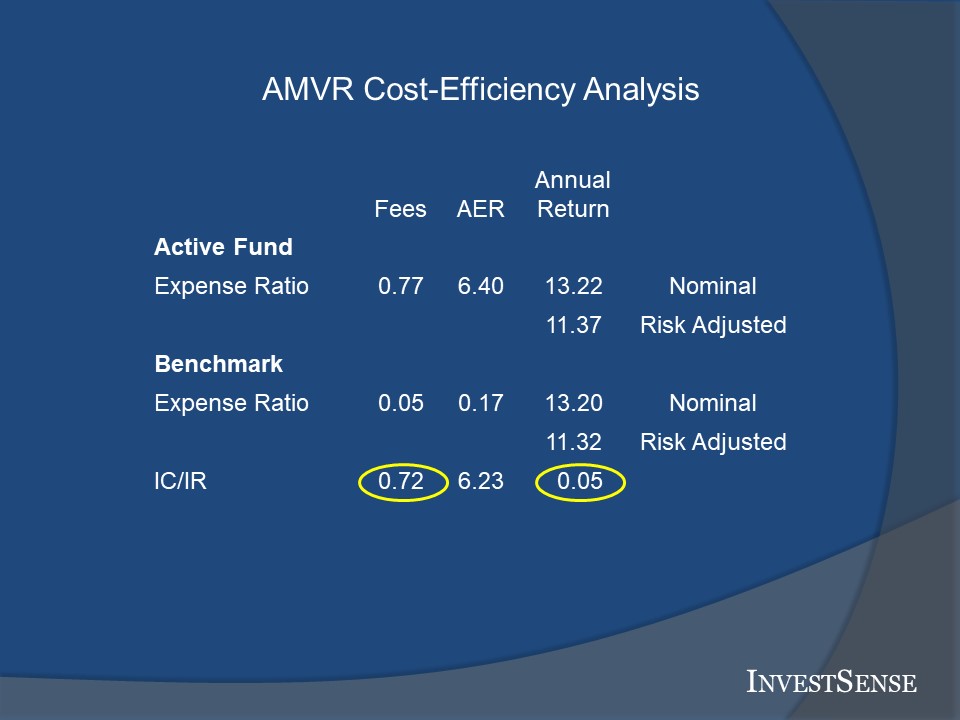
In this case, the answer to both questions is “no.” Therefore, the fund is not a prudent investment choice. Both the Department of Labor and the General Accountability Office2 are on record as saying that each additional one percent in fees/costs reduces an investor’s end-return by approximately 17 percent over a 20-year period. Using those guidelines and viewing the fund’s underperformance as an opportunity cost, an investment in the fund shown would project to a loss of 43.69 percent. And yet, Congress and the financial services ignore such overwhelming evidence and try to defend such investor abuse as the need for “choice.” A cost-inefficient investment never has, and never will, constitute a legitimate legal “choice.”

Investors face the same sort of misleading marketing tactics with regard to annuities. Annuities were always the biggest problem I faced during my compliance days, I had the pleasure of working with some incredibly talented and dedicated brokers and investment advisers during my compliance days.

Then there were the annuity folks, both brokers and wholesalers. Mondays are usually when broker-dealers hold their weekly sales meetings. I remember the day the annuity wholesaler came in to pitch the new equity indexed annuity (EIA), more commonly known as indexed annuities and fixed indexed annuities (FIAs).

Knowing my position on annuities in general, the brokers kept turning around and looking at me. I was sitting in the back of the room, next to the brokerage director, who leaned over and asked me if we were going to be selling EIAs. I told him I was not going to sign off on any and he agreed. I still maintain that they are overly complicated and deliberately mislead investors. For more information on annuities, read my article on the fiduciary liability issues inherent in annuities

Supreme Court Justice Louis Brandeis once said that “sunshine is the best disinfectant.” On the other hand, transparency is the financial service industry’s kryptonite. Annuities are Exhibit A for that argument, as they seem to be included in the SEC’s annual list of leading consumer complaints.

“Framing” refers to the method used to present an idea or product in hopes of receiving the desired response. A familiar saying in the investment industry is that “annuities are sold, not bought.” To sell a “problem” product, brokers are often told to “put lipstick on a pig” and/or “Sell the sizzle, not the steak.”

Annuity salespeople typically frame their sales presentation using the spiel that annuities offer “guaranteed income for life” and “who does not want guaranteed income for life.” But as the late Peter Katt used to always warn, the key question is “at what cost?”

When I speak to groups on the subject of annuities, I always use the following slide to frame my own presentation:

“At what cost” indeed. Still interested in annuities and “guaranteed income for life. Guaranteed income in retirement is all good and well, However, there other viable options such as dividends and bonds that provide the income without requiring an investor to make such sacrifices and destroy their estate plans for their family and other heirs.

Investors say that the annuity salespeople do not disclose that aspect of many annuities to them, just “guaranteed income for life.” In fairness, insurance salespeople are typically not held to a fiduciary standard, only, at best, a “best interest” standard. Even then, the level of enforcement of regulations by some state insurance commissioners leave much to desire.

Going Forward
When it comes to investor protection, I am admittedly biased by my experiences as both a securities compliance director, a plaintiff’s attorney, and an ERISA attorney/risk management counsel. In my public presentations to investors and plan sponsors, I offer the following quote from the Court in Archer v. SEC:

The business of trading in securities is one in which opportunities for dishonesty are of constant recurrence and ever present. It engages acute, active minds, trained to quick apprehension, decision and action. The Congress has seen fit to regulate this business. Though such regulation must be done in strict subordination to constitutional and lawful safeguards of individual rights, it is to be enforced notwithstanding the frauds to be suppressed may take on more subtle and involved forms than those in which dishonesty manifests itself in cruder and less specialized activities.3

Unfortunately, today’s investors must assume a greater role in protecting their best interests. A good starting point is to always ask a broker or insurance salesperson whether they will be acting in a fiduciary capacity and in accordance with a fiduciary standard in providing recommendations and other investment advice. If they say “yes,” then ask them if they are willing to put that promise in writing, signed by both them and their supervising broker-dealer/insurance company.

Brokers and insurance agents will typically refuse to provide such guarantees in writing, responding that they are not legally required to provide such promises. That may or not be true, as some states do hold brokers and insurance professionals to a fiduciary standard, or at least a best interest standard.”

Hopefully, this post has convinced the reader of both their right and prudence in insisting on the higher level of care and liability of a fiduciary standard from those advising them and/or managing their financial affairs.

Notes
1. Financial Planning Association v. Securities and Exchange Commission, 482 F.3d 481 (D.C.C. 2007)
2. Pension and Welfare Benefits Administration, “Study of 401(k) Plan Fees and Expenses,” (“DOL Study) http://www.DepartmentofLabor.gov/ebsa/pdf; “Private Pensions: Changes needed to Provide 401(k) Plan Participants and the Department of Labor Better Information on Fees,” (GAO Study”).
3. Archer v. Securities and Exchange Commission, 133 F.2d 795, 803 (8th Cir. 1943).

Copyright InvestSense, LLC 2023. All rights reserved.

This article is for informational purposes only, and is neither designed nor intended to provide legal, investment, or other professional advice since such advice always requires consideration of individual circumstances.  If legal, investment, or other professional assistance is needed, the services of an attorney or other professional advisor should be sought.

Posted in Active Management Value Ratio, AMVR, annuities, Asset Protection, Best Interests, Consumer Protection, cost efficient investing, cost-effficiency, Equity Indexed Annuities, Estate Planning, Fixed Indexed Annuities, investing, Investment Advice, Investment Advisors, investments, portfolio planning, Portfolio Planning, Wealth Accumulation, Wealth Distribution, Wealth Management, Wealth Preservation | Tagged , , , , , , , , , , , | Leave a comment

1+1=34: A Step-by-Step Guide to Wealth Management and Preservation Using the Active Management Value Ratio

In a recent Wall Street Journal article, Jason Zweig discussed the lack of transparency with regard to financial advisers.1 While I agree with his assessment, I believe that he may have actually underestimated the damage resulting from such lack of transparency.

The financial services industry usually restricts their mutual fund investment recommendations to the overpriced and consistently underperforming funds of their broker-dealer’s “preferred providers.” Many investors are totally unaware of this system, which is designed to benefit the brokers/financial advisers and their broker-dealers at the expense of the investors.

Mutual funds pay some sort of financial consideration in order to gain access to a broker-dealer’s brokers. The regulatory bodies who are charged with protecting public investors, the Securities and Exchange Commission (SEC) and the Financial Investment Regulatory Association (Finra), actually condone such programs.

As proof, one needs look no further than the SEC’s recently enacted regulation, Regulation Best Interest (Reg BI)2. While promoted as requiring that brokers/financial advisers always put the best interests of their customers first, a little-known loophole, the “readily available alternatives” language, actually allows brokers/financial advisers to limit their recommendations to the aforementioned cost-inefficient products of their broker-dealer’s “preferred providers.

As a former securities compliance director overseeing both general stockbrokers and registered investment advisers (RIAs), I believe that such programs and regulations violate both the letter and the spirit of applicable securities law, protecting Wall Street’s interests rather those of public investors.

InvestSense submitted the following public comment during the consideration period on Reg BI:

While I appreciate the fact that the SEC recognizes the need to address the fiduciary issue, I have concerns about whether the SEC is sincere about adopting a meaningful fiduciary standard that will provide the protection that investors need, or just putting on a show that will result in a watered-down version of FINRA’s “suitability” standard.

The SEC’s mission statement clearly indicates that protection of investors is a primary purpose. Judicial decisions involving the agency have clearly stated that it is the SEC’s duty to protect investors, not the investment industry.

In Norris & Hirshberg v. SEC (177 F.2d 228), the court rejected the defendant’s suggestion that the securities laws were intended to protect the investment industry, stating that

“[t]o accept it would be to adopt the fallacious theory that Congress enacted existing securities legislation for the protection of the broker-dealer rather than for the protection of the public. On the contrary, it has long been recognized by the federal courts that the investing and usually naive public need special protection in this specialized field.” (at 233)

In Archer v. SEC (133 F.2d 795), the court echoed those same concerns, stating that

“[t]he business of trading in securities is one in which opportunities for dishonesty are of constant recurrence and ever present….The Congress has seen fit to regulate this business.”

Any suggestion that a “suitability,” or “just OK,” standard provides the same protection that a true fiduciary, or “best interest at all times,” standard is disingenuous and a blatant violation of the agency’s mission statement and the very purpose for which the agency was formed.

The need for a meaningful fiduciary standard for anyone financial services to the public can also be seen in the investment firms retreating from being held to any fiduciary duties in connection with 401(k) plans, arguably in order to engage in the same abusive marketing strategies that led to the DOL’s fiduciary standard in the first place.

In FINRA Regulatory Notice 12-25, FINRA stated that the suitability standard and the best interest standard are “inextricably intertwined.” If one accepts that as true, then the SEC should have no objection to clearly defining the legal duty owed to investors as a “fiduciary” duty and defining the duty using the term fiduciary and the terms set out in the ’40 Act, since the best interest standard requires a higher standard of conduct(fiduciary)than the suitability standard just OK).

The late General Norman Schwarzkopf once stated that “the truth is, we all know the right thing to do. The hard part is doing it.” For the sake of American investors, follow the court’s admonition in Norris & Hirshberg and do the right thing and properly protect American investors, instead of the investment industry. by adopting a meaningful fiduciary standard.

As expected, the SEC totally disregarded my comments and enacted Reg BI with the “readily available alternatives” loophole. To be fair, Reg BI may actually provide much needed investor protection in some cases. However, in my opinion, the “reasonably available alternatives” loophole totally destroys any hope of investor protection with regard to the quality of advice issue.

The Active Management Value RatioTM
Recognizing both the shortcomings of Reg BI and the investors’ need for investor protection, I created a simple metric, the Active Management Value RatioTM (AMVR), which allows investors to quickly and easily evaluate the prudence of actively managed mutual funds relative to comparable index funds. The AMVR is based primarily on the groundbreaking concepts of investment icons such as Nobel laureate Dr. William F. Sharpe and Charles D, Ellis.

Sharpe helped establish the general framework of mutual fund analysis, stating that

Properly measured, the average actively managed dollar must underperform the average passively managed dollar, net of costs…. The best way to measure a manager’s performance is to compare his or her return with that of a comparable passive alternative.3

Ellis then contributed the concept of comparing incremental cost versus incremental returns, stating that

So, the incremental fees for an actively managed mutual fund relative to its incremental returns should always be compared to the fees for a comparable index fund relative to its returns. When you do this, you’ll quickly see that that the incremental fees for active management are really, really high—on average, over 100% of incremental returns.4

One of the benefits of the AMVR is the simplicity in interpreting the metric’s results. In analyzing an AMVR analysis, the user only needs to answer two simple questions:

(1) Did the actively managed fund provide a positive incremental return?
(2) If so, did actively managed fund’s positive incremental return exceed the fund’s incremental costs.

If the answer to either of these questions is “no,” then, under the Restatement’s standards, the actively managed fund is imprudent relative to the benchmark index fund.

Here, the AMVR analysis is of a actively managed mutual fund from a fund family that brokers/financial advisers often recommend due to the high commissions available to them. However, using the publicly reported, or nominal, returns, the actively managed fund would be an imprudent investment relative to the comparable index fund since the active fund had incremental costs of 48 basis points and failed to provide any positive incremental return. Any investment whose costs exceed its returns is obviously not a wise investment choice.

“Basis points” is a common term used in the financial services industry. Technically, it is 1/100th of 1 percent (0.01). To simplify the AMVR cost/benefit analysis for investors, I often suggest that they “monetize” the cost by simply thinking in terms of dollars instead of basis points. Here. the question would be whether an investor would be willing to pay $48 in order to receive $13 in return. Obviously not.

The problem with nominal returns is that they are often misleading, as they do not consider important factors such as risk assumed and the implicit costs due to the correlation of returns between comparable investments.

Load-Adjusted Returns
Unlike most index funds, actively managed funds often charge investors a “front-end load,” a fancy term for the commissions actively managed funds pay brokers/financial advisers for selling their funds. The amount of the front-end load is immediately deducted from an investor’s initial investment in the fund, effectively reducing the investor’s actual investment. As a result, even if the actively managed fund achieved the same return as the index fund, the investor in the active fund will receive less.

This reduction in return is often overlooked, but should not be. Since the overwhelming evidence is that actively managed are cost-inefficient, with most of them not even being able to cover their costs, this lag in returns is likely to continue over time.

Studies have shown that even relatively minor costs and losses can dramatically impact an investor’s end-return. The General Accounting Office has estimated that over a twenty-year period, each additional 1 percent in costs/losses (100 basis points) reduces an investor’s end-return by approximately 17 percent,5 Combining the incremental cost and incremental loss in the example above, the 219 loss in basis points would result in a loss of more than one- third of an investor’s end-return.

Risk-Adjusted Returns
Another factor that investors need to consider is the impact of risk on their investment returns. A common saying is that returns are a factor of risk. A basic concept of prudent investing is that an investor has a right to receive a commensurate return for the additional costs and risks inherent in an investment. Again, more often than not, actively managed funds do not provide that commensurate return.

Here, the actively managed fund actually has a slightly lower level of risk. As a result, the actively managed fund’s performance relative to the comparable index improves, reducing the amount of its incremental cost. However, the actively managed fund still underperforms the index fund and is still cost-inefficient relative to the index fund, especially when incremental costs is considered.

Some investors avoid addressing risk-related returns due to the calculations involved. The calcualtions are actually quite simple. However, several online sites offer risk-adjusted return data, including marketwatch.com.

Correlation-Adjusted Costs
The next step is to determine if the actively managed fund in our AMVR analysis provides a commensurate return relative to the active fund’s incremental costs. The analysis indicates that the active fund charges an incremental cost of 48 basis points; yet provides no benefit to an investor in the actively managed fund that to offset such incremental costs.

While that scenario is troubling enough, does it actually indicate the full extent of the active fund’s cost impact relative to the index fund? The risk-adjusted AMVR chart shows that an investor essentially gets a similar return for just 17 basis points and avoid the incremental cost of 48 basis point. As John Bogle explained, an investor gets to keep what they do not pay for, in this case an additional 69 basis points in the return.

But does that simple calculation accurately express the full extent of the impact of the actively managed fund with regard to the fiduciary prudence of the active fund? Ross Miller’s Active Expense Ratio (AER) suggests that the cost-inefficiency of many actively managed funds may be even worse than appears at first glance.

Miller’s research suggests that the effective expense ratio of many actively managed funds is often understated by as much as 300-400 percent, sometimes even more. Miller explained the importance of the Active Expense Ratio and Active Weight (AW) metrics as follows:

Mutual funds appear to provide investment services for relatively low fees because they bundle passive and active funds management together in a way that understates the true cost of active management. In particular, funds engaging in ‘closet’ or ‘shadow’ indexing charge their investors for active management while providing them with little more than an indexed investment. Even the average mutual fund, which ostensibly provides only active management, will have over 90% of the variance in its returns explained by its benchmark index.7

The AER compares an active fund’s incremental costs to the fund’s correlation of returns to a comparable index fund. In this case, the actively managed fund has a 97 percent correlation to the index fund. Using Miller’s methodology, that would suggest that the actively managed fund is effectively providing only 15 percent in active management. Based on the AER, the investor in the actively managed fund would be paying an implicit/effective expense ratio of 283 basis points, resulting in an incremental cost of 266 points. Using our previous monetization example, a smart investor would not pay $266 to only receive $17 in return?

Going Forward
While we have gone through the various levels of AMVR analysis, the good news for investors is that in most cases, the cost-inefficiency is exposed by just a simple AMVR analysis based on the incremental costs and incremental returns based on the actively managed and index funds’ nominal numbers.

The basic AMVR requires nothing more what one judge referred to as “simple third grade math” when an attorney attempted to block me from using the AMVR in a case. Investors who are willing to learn more about the AMVR from other posts on this blog and use the format shown in the examples herein can easily prevent unnecessary investment losses and better protect their financial security.

For those who do use a broker or financial adviser to manage their account, I have recommended that they require the broker/financial adviser to provide them with a quarterly AMVR report for each investment in their portfolio, using exactly the same format as shown herein. Many investors have reported that their broker/financial adviser have agreed to do so with “improvements.”

My experience has been that such “improvements are actually attempts to avoid the transparency Zweig talked about, attempts to hide wrongdoing and/or fiduciary violations. As Justice Brandeis once said, “sunlight is the best disinfectant.”

Posted in 401k, Active Management Value Ratio, AMVR, Best Interests, Consumer Protection, cost efficient investing, cost-effficiency, ERISA, Fiduciary, fiduciary prudence, fiduciary responsibility, Fiduciary Standard, investing, Investment Advice, Investment Advisors, Investment Fraud, Investment Portfolios, investments, Investor Protection, Portfolio Construction, portfolio planning, Portfolio Planning, Uncategorized, Wealth Accumulation, Wealth Management, Wealth Preservation | Tagged , , , , , , , , , , , | Leave a comment

At What Cost?: Annuities, Cryptocurrency, and 401(k) Plans

For many people, their 401(k) or 403(b) accounts are their primary retirement savings. So, it’s only natural that they want their 401(k) or 403(b) plan to offer investment options that are truly in their best interests and their beneficiaries’ best interest.

Pension plans are administered by a plan sponsor. Pension plan sponsors are legally fiduciaries. A fiduciary’s duties to the plan’s participant’s and their beneficiaries are the highest duties under the law.

A [fiduciary] is held to something stricter than the morals of the marketplace.  Not honesty alone, but the punctilio of an honor the most sensitive, is the standard of behavior….1

Fiduciary law is a combination of three types of law–trust, agency and equity. The basic concept of fiduciary law is fundamental fairness.

The Supreme Court has consistently recognized the fiduciary principles set out in the Restatement (Third) of Trusts (Restatement) as guidelines for fiduciary responsibility, especially for plan sponsors.

ERISA is essentially a codification of the Restatement (Third) of Trusts (Restatement). SCOTUS has recognized that the Restatement is a legitimate resource for the courts in resolving fiduciary questions, especially those involving ERISA.2

Under the Restatement, loyalty and prudence are two of the primary duties of a fiduciary. A fiduciary’s duty of loyalty requires that a plan sponsor act solely in the best interests of the plan participants and their beneficiaries. A fiduciary’s duty of prudence requires that a plan sponsor exercise reasonable care, skill, and caution in managing a plan, specifically with regard to controlling unnecessary costs and risks.

Against that backdrop, plan participants and their beneficiaries are now confronted with the potential issues of being offered annuities and crypto currencies within a 401(k) plan. I believe that both assets are inappropriate for 401(k) and unnecessarily expose plan participants and their beneficiaries to unnecessary risks, including excessive costs, consistently underperformance and the possible loss of a significant portion of their entire pensions account to insurance companies, rather than intended beneficiaries

Annuities
While an exhaustive analysis of annuities is beyond the scope of this post, I want to address three of the most common types of annuities and the fiduciary issues involved with each. One of the fiduciary issues involved with annuities is their complexity. The analyses herein will be based on the simple, garden variety of each of the three annuities.

1. Immediate Annuities (aka Income Annuities)
These annuities are often recommended to provide supplemental income in retirement. In most cases, immediate annuities can be used to provide income for life or for a certain period of time, e.g., 5, 10, 15 or 20 years.

The key question in evaluating annuities, or any other investment, should always be “at what cost?” With annuities, you generally have annual costs as well as additional optional costs for various “bells and whistles.” While costs vary, a basic average annual cost for immediate annuities seems to be 0.7 percent. The average costs for various additional options with all annuities seem to be an additional 1.0 percent. However, it is a plan sponsor’s duty to always ascertain the exact costs.

Plan sponsors need to always remember this mantra – “Costs matter.” Costs do matter, a lot. The General Accounting Office has stated that each additional 1 percent in costs/fees reduces an investor’s end-return by approximately 17 percent over a twenty-year period. 3

Peter Katt was an honest and objective insurance adviser. During my compliance career, he was my trusted go-to resource. While he passed away in 2015, the lessons I learned from him will always be invaluable. I strongly recommend to investors and investment fiduciaries that they Google his name and read his articles, especially those he wrote for the AAII Journal.

Katt’s thought on immediate annuities include:

The immediate annuity is for people who want the absolute security that they can’t outlive their nest egg. The problem is that there is nothing left over for your heirs.4

While annuities often offer options to address this issue, such options often result in reduced monthly payments and/or additional costs.

Katt always said to get the annuity salesmen to provide a written analysis providing the breakeven analysis for an annuity, the estimated time that would be required for an annuity owner to recover their original investment in the annuity. He told me that breakeven periods of twenty years or more are common, making it unlikely that the annuity owner will ever recover their original investment. And remember, with a life-only immediate annuity, once the annuity owner dies, the balance in the annuity goes to the annuity issuer, not the annuity owner’s heirs.

He also told me to always ask the annuity salesman for the APR that was used in calculating the breakeven point. The APR is the interest rate that annuity issuers typically use in determining an annuity’s payments.

One of the drawbacks with immediate annuities is that once an interest rate is set, that will be the applicable interest rate for the period of the annuity. Again, some annuities may offer options to avoid this inflexibility…at an additional cost.

The inflexibility of an annuity’s interest rate results in purchasing power risk for an annuity owner. This risk increases as the period of the annuity increases. Purchasing power risk refers to the risk that the annuity’s payments will lose their buying power over the years due to inflation. Some annuities provide for “step-ups” in rates…at an additional cost.

Katt’s advice-anyone considering an immediate annuity should first build a balanced portfolio consisting of stocks and bonds to ensure flexibility, and then invest augment that portfolio with a reasonable am0unt in the immediate annuity. While some annuity salesmen will argue for an “all or nothing” approach in order to maximize their commission. Prudent investors will follow Katt’s advice.

Perhaps the strongest argument against including immediate in 401(k) and other pension plans comes from a study by three well-respected experts on the subject. In analyzing when a Single Premium Immediate Annuities (SPIAs), probably the most popular type of immediate annuity, would make sense, the three experts stated that

Results suggest that only when the possibility of outliving 70 percent or more of a cohort exists, and then only at elderly ages. For ages younger than 80, assets are best kept within the family, because both inflation and possible future market returns have time to do better than SPIA lifetime sums.5

Based upon my experience, very few 401(k) plans have plan participants aged 80 or older. I predict that plan sponsors who decide to offer immediate annuities, in any form, in their plans can expect to see that quote again, especially if I am involved in the litigation.

2. Fixed Indexed Annuities (fka Equity Indexed Annuities)
From what I have read and heard, the annuity industry’s plan to focus on including annuity options within 401(k) plans by imbedding fixed indexed annuities options within target data funds.

Target date funds are controversial investments that attempt to create investment portfolios that are appropriate based on the investor’s estimated retirement, or target, date. Target date funds have typically designed portfolios consisting of equity and fixed income investments.

From the reports I have read, the annuity industry plans to imbed a fixed income annuity aspect into target date fund, and then gradually increasing the percentage of the allocation to the annuity sector within the target date fund. When the target date is met, the annuity issuer would reportedly offer the plan participant the option to actually purchase the fixed indexed annuity.

So what would be wrong with that? Dr. William Reichenstein, finance professor emeritus at Baylor University sums the primary issue perfectly.

The designs of equity index annuities (EIAs) and bond indexed annuities ensure that they must offer below-market risk-adjusted returns compared with those available on portfolios of Treasurys and index funds. Therefore, this research implies that indexed annuity salesmen have not satisfied and cannot satisfy SEC requirements that they perform due diligence to ensure that the indexed annuity provides competitive returns before selling them to any client.6

While EIAs/FIAs are technically insurance products, not securities, Dr. Reichenstein’s analysis is still applicable with regard to a fiduciary’s duties of loyalty and prudence. If the design of these products ensures that they cannot offer competitive returns to those of alternative investments, then how does a plan sponsor, or any fiduciary for that matter, plan to meet their fiduciary duty of loyalty and prudence?

As regulators emphasize, before an insurance agent can sell an annuity, he or she must perform due diligence to ensure that the investment offered ex ante competitive returns. Therefore, it is appropriate to compare the net returns available in an equity-indexed annuity to those available on similar-risk investments held outside an annuity.7

[By] design, indexed annuities cannot add value through security selection ….[T]he hedging strategies [used by equity-indexed annuities] ensure that the individuals buying equity-indexed annuities will bear essentially all the risks. Conseqently, all (ital) indexed annuities must (ital) produce risk-adjusted returns that trail those offered by readily available marketable securities by their spread, that is, by their expenses including transaction costs.8

The reference to design refers to the fact that managers of indexed annuities buy Treasury securities and index options, but do not engage in individual security selection. Furthermore, indexed annuities typically impose restrictions on the amount of return that an investor can actually receive. Therefore, the combination of the design of these products and the restrictions on returns typically imposed by EIAs/FIAs ensure a fiduciary breach.

So, even though the annuity industry markets these indexed annuities by emphasizing stock market returns, the majority of fixed indexed annuity owners are guaranteed to never receive the actual returns of the stock market. While some annuity firms are marketing so-called “uncapped” fixed indexed annuities, they may still impose restrictions, and such “uncapped” returns…come with additional costs.

The restrictions and conditions that fixed indexed annuities naturally vary. During my time as a compliance director, the fixed indexed annuities I saw imposed an 8-10 percent cap and a participation rate of 80 percent. What that meant was that regardless of the applicable market index, with a cap of 10 percent, the most the annuity owner could receive was 10 percent of the index’s return.

As if that was not unfair enough, that 10 percent return was then further reduced by the annuity’s participation rate. So, with a participation rate of 80 percent, the maximum return an investor could receive in our example was 8 percent.

Reichenstein points out even more inequities, noting that  

Because interest rates and options’ implied volatilities change, the insurance firm almost always retains the right to set at its discretion at least one of the following: participation rate, spread, and cap rate.9

The one question that I always asked of fixed indexed annuity wholesalers, but still remains unanswered, was what happened to the excess return generated from the index options after the caps and participation rates were applied. Still waiting for an answer 

And finally, a simple explanation of how fixed indexed annuity companies further manipulate returns to ensure that they protect their interests first.

From AmerUS Group financial statements, ‘Product spread is a key driver of our business as it measures the difference between the income earned on our invested assets and the rate which we credit to policy owners, with the difference reflected as segment operating income. We actively manage product spreads in response to changes in our investment portfolio yields by adjusting liability crediting rates while considering our competitive strategies….’ This spread ensures that the annuity will offers noncompetitive risk-adjusted returns.10

Equity-indexed annuities generally do not credit owners with the dividends paid on the index used in calculating equity returns. Many indexed owners are not aware of this fact, or its significance. For example, historically over 40 percent of the S&P 500 Index’s compounded returns has come from dividends paid on its underlying stocks.

I could go on to discuss additional issues as single entity credit risk and illiquidity risks, but I think investment fiduciaries get the picture. The evidence against fixed index annuities establishes that they are a fiduciary breach simply waiting to happen. I strongly recommend that plan sponsors and other investment fiduciaries read Reichenstein’s analysis before deciding to offer fixed indexed annuities, in any shape or form, in their plans or to clients.

3. Variable Annuities
Any fiduciary that sells, uses, or recommends a variable annuity has breached their fiduciary duty…period. Katt summed it up perfectly:

Variable annuities (VAs) are flawed because they covert capital gains into ordinary income and have considerably higher expenses compared with comparable mutual funds. For this reason they are quite unsuitable for most investors.11

Exhibit A
Benefit – VAs provide a death benefit to limit a VA owner’s downside risk.

[T]he fee [for the death benefit] is included in the so-called Mortality and Expense (M&E) risk charge. The M&E risk charge is a perpetual fee that is deducted from the underlying assets in the VA, above and beyond any fund expenses that would normally be paid for the services of managed money.12

[T]he authors conclude that a simple return of premium death benefit is worth between one to ten basis points, depending on purchase age. In contrast to this number, the insurance industry is charging a median Mortality and Expense risk charge of 115 basis points, although the numbers do vary widely for different companies and policies.13

The authors conclude that a typical 50-year-old male (female) who purchases a variable annuity—with a simple return of premium guaranty—should be charged no more than 3.5 (2.0) basis points per year in exchange for this stochastic-maturity put option. In the event of a 5 percent rising-floor guaranty, the fair premium rises to 20 (11) basis points. However, Morningstar indicates that the insurance industry is charging a median M&E risk fee of 115 basis points per year, which is approximately five to ten times the most optimistic estimate of the economic value of the guaranty.14

Excessive and unnecessary costs violate the fiduciary duty of prudence. The value of a VA’s death benefit is even more questionable given the historic performance of the stock market. As a result, it is unlikely that a VA owner would ever need the death benefit. These two points have resulted in some critics of VAs to claim that a VA owner needs the death benefit like a duck needs a paddle.”

Exhibit B
Benefit – VAs provide a death benefit to limit a VA owner’s downside risk.

At what cost? VAs often calculate a VAs annual M&E charge/death benefit based on the accumulated value within the VA, even though contractually limit their legal liability under the death benefit to the VA owner’s actual investment in the VA.

As a result, over time, it is reasonable to expect that the accumulated value within the VA will significantly exceed the VA owner’s actual investment in the VA. This method of calculating the annual M&E, known as inverse pricing, results in a VA issuer receiving a windfall equal to the difference in the fee collected and the VA issuer’s actual costs of covering their legal liability under the death benefit guarantee.

As mentioned earlier, fiduciary law is a combination of trust, agency and equity law. A basic principle of fiduciary law is that “equity abhors a windfall.” The fact that VA issuers knowingly use the inequitable inverse pricing method to benefit themselves at the VA owner’s expense results in a fiduciary breach for fiduciaries who recommend, sell or use VAs in their practices or in their pension plans.

The industry is well aware of this inequitable situation. John D. Johns, a CEO of an insurance company, addressed these issues in an article entitled “The Case for Change.”

Another issue is that the cost of these protection features is generally not based on the protection provided by the feature at any given time, but rather linked to the VA’s account value. This means the cost of the feature will increase along with the account value. So over time, as equities appreciate, these asset-based benefit charges may offer declining protection at an increasing cost. This inverse pricing phenomenon seems illogical, and arguably, benefit features structured in this fashion aren’t the most efficient way to provide desired protection to long-term VA holders. When measured in basis points, such fees may not seem to matter much. But over the long term, these charges may have a meaningful impact on an annuity’s performance.15

In other words, inverse pricing is always a breach of a fiduciary’s duties of both loyalty and prudence, as it results in a windfall for the annuity issuer at the annuity owner’s expense, a cost without any commensurate return, which also violates Section 205 of the Restatement of Contracts.

Exhibit C
Benefit – VAs allow their owners the opportunity to invest in the stock market and increase their returns.

VAs offer their owners an opportunity to invest in equity-based subaccounts. Subaccounts are essentially mutual funds, usually similar to the same mutual funds that investors can purchase from mutual fund companies in the retail market.

While there has been a trend for VAs to offer cost-efficient index funds as investment options, many VA subaccounts are essentially same overpriced, consistently underperforming, i.e., cost-inefficient, actively managed mutual funds offered in the retail market. As a result, VA owners’ investment returns are typically significantly lower than they would have been when compared to returns of comparable index funds.

Exhibit D
Benefit – VAs provide tax-deferral for owners.

So do IRAs. So do any brokerage account as long as the account is not actively traded. However, dividends and/or capital gain distributions are taxed when they occur.

The key point here is that IRAs and brokerage accounts usually do not impose the high costs and fees associated with annuities. This is especially true of VAs, where annual fees of 3 percent or more are common, even higher when riders and/or other options are added.

Remember the earlier 1/17 note? Multiply 3 by 17 to see the obvious fiduciary issues regarding the fiduciary duties of loyalty and prudence. 

Although not an issue for plan sponsors, another “at what cost” fiduciary issue has to do with the adverse tax implications of investing in non-qualified variable annuities (NQVA). Non-qualified variable annuities are essentially those that are not purchased within a tax-deferred account, e.g., a 401(k)/403(b) account, an IRA account.

When investors invest in equity investments, they typically are not taxed on the capital appreciation until such gains are actually realized, such as when they sell the investment or, in the case of mutual funds, when the fund makes a capital gains distribution.

In many cases, investors can reduce any tax liability by taking advantage of the special reduced tax rate for capital gains. However, withdrawals from a NQVA do not qualify for the lower capital gains tax. All withdrawals from a NQVA are considered ordinary income, and thus taxed at a higher rate than capital gains. An investment that increases its owner’s tax liability by converting capital gains into ordinary income is hardly prudent or in an investor’s “best interest.”

Bottom line – there are other less costly investment alternatives available that provide the benefit of tax deferral. While they may not offer the same guaranteed income, they provide other significant benefits, while avoiding some of the risks associated with VAs, e.g., reduced flexibility, purchasing power risk, higher taxes.

Exhibit E
Benefit: Annuity owners do not pay a sales charge, so more of their money goes to work for them.

The statement that variable annuity owners pay no sales charges, while technically correct, is misleading. Variable annuity salesmen do receive a commission for each variable annuity they sell, such commission usually being in the range of 6-7 percent of the total amount invested in the variable annuity.

While a purchaser of a variable annuity is not directly assessed a front-end sales charge or a brokerage commission, the variable annuity owner does reimburse the insurance company for the commission that was paid. The primary source of such reimbursement is through a variable annuity’s various fees and charges, particularly the M&E charge.

To ensure that the cost of commissions paid is recovered, the insurance company typically imposes surrender charges on a variable annuity owner who tries to cash out of the variable annuity before the expiration of a certain period of time. The terms of these surrender charges vary, but a typical surrender charge schedule might provide for an initial surrender charge of 7 percent for withdrawals during the first year, decreasing 1 percent each year thereafter until the eighth year, when the surrender charges would end. There are some surrender charge schedules that charge a flat rate, such as 7 percent, over the entire surrender charge period.

Cryptocurrency
Fidelity Investments recently announced that it would begin offering a new fund that would allow 401(k) plans to offer a cryptocurrency option within the plan. The reaction was immediate and divided. And now news that Bitcoin and other cryptocurrencies have suffered a cumulative $200 billion dollar loss.

Since there are still a number of issues that need to be address ed, especially the concerns raised by regulators, including the Department of Labor16 and the Securities & Exchange Commission17, I will simply suggest that plan sponsors and other investment fiduciaries should wait until the regulators have issued guidelines on this topic.

One thing I will address is the notion that because investors may want to invest in cryptocurrency is no reason for a plan sponsor or other investment fiduciary to do so. First, a plan sponsor has no obligation, legal or otherwise, to include an investment option in a plan simply because one or more plan participant wants to invest in such an option. A plan sponsor, a trustee, or any other investment fiduciary has two primary duties, the duty of loyalty and the duty of prudence.

With all the acknowledged concerns about cryptocurrency, from susceptibility to hacked accounts resulting in significant losses, the volatility of such investments, and questions regarding the concept/ structure of such investments, prudence is the best course for all fiduciaries at this point. For plan participants that want to invest in cryptocurrencies, they are free to open up retail brokerage accounts and trade in such investments.

Going Forward
In addition to being a fiduciary, I also represent investors who have suffered losses due to questionable investment recommendations and poor financial advice. Far too often, such losses can be traced to incomplete and/or misrepresentations.

For example, annuity salesmen marketing annuities often stress the “guaranteed income for life” aspect of annuities, without explaining that to receive such guaranteed income, the annuity owner has to “annuitize,” of give up all rights to the accumulated value of the annuity. Simply put, due to the way annuities are designed, the insurance company, not your family or other beneficiaries, will receive the benefit of your lifelong labor.

My experience has been that annuity salesmen often fail to explain such disadvantages to customers, only disclosing the “guaranteed income for life” mantra. As a former securities compliance director, I am well aware of the “sell the sizzle, not the steak” marketing strategy where the salesman focuses on the potential benefits of a product, not its disadvantages. Transparency and full disclosure are the financial services industry’s kryptonite.

However, a plan sponsor’s fiduciary duties are inviolate. There are no “mulligans” or “do overs” in fiduciary law. As the courts have repeatedly pointed out, “A pure heart and an empty head’ are no defense to allegations of the breach of one’s fiduciary duties.18

Plan sponsors have a duty to know every aspect of every product they select to offer within their plan. Unfortunately, far too often plan sponsors ignore such duties and simply rely on the representations of the plan adviser and/or other third parties, whose advice may be tainted by the commissions or other compensation they can generate from a plan. The widespread impact of these failures of sponsors to perform their fiduciary duties, combined with self-conflicted advice from third parties, is the reason there is currently so much litigation involving 401(k) and 403(b) plans.

If anything positive comes out of the current debate over the inclusion of annuities and/or cryptocurrencies in 401(k) plans, hopefully it will be a greater recognition and appreciation of the importance of one’s fiduciary duties by plan sponsors and other investment fiduciaries so as to avoid causing unnecessary losses for plan participants and their families.

Resources
There are a number of resources available online that can be used to analyze annuities in terms of breakeven analysis. Google “annuity breakeven analysis” to find them. In my practice, I often use the Annuity Break-Even Calculator — VisualCalc program, which compares an annuity with an alternative equity investment. The graphic makes the results easier to understand.

The article by Frank, Mitchell, and Pfau provides detailed instructions on how to perform annuity breakeven analyses using Microsoft Excel.

Notes
1. Meinhard v. Salmon, 249 N.Y. 458, 464 (1928).
2. Tibble v. Edison International, 135 S. Ct 1823 (2015).
3. Pension and Welfare Benefits Administration, “Study of 401(k) Plan Feess abd Expenses,” (“DOL Study”). http://www.DepartmentofLabor.gov/ebsa/pdf; “Private Pensions: Changes needed to Provide 401(k) Plan Participants and the Department of Labor Better Information on Fees,” (GAO Study”), http://www.gao.gov/new.item/d0721.pdf
4. Peter C. Katt, “The Good, Bad, and Ugly of Annuities,” AAII Journal, November 2006, 34-39
5. Larry R. Frank, Sr., John B. Mitchell, and Wade Pfau, “Lifetime Expected Income Breakeven Comparison Between SPIAs and Managed Portfolios,” Journal of Financial Planning, April 2014, 38-
6. William Reichenstein, , “Financial analysis of equity-indexed annuities,” Financial Services Review 18 (2009) 291-311
7. Reichenstein, 302.
9. Reichenstein, 303.
10. Reichenstein, 309.
11. Katt, 35.
12. Moshe Miklevsky and Steven E. Posner, “The Titanic Option: Valuation of the Guaranteed Minimum Death Benefit in Variable Annuities and Mutual Funds,” Journal of Risk and Insurance, Vol. 68, No. 1 (2009), 91-126, 92.
13. Milevsky and Posner, 94.
14. Milevsky and Posner, 122.
15. John D. Johns, “The Case for Change,” Financial Planning, September 2004, 158-168.
16. Department of Labor, “Compliance Assistance Release No. 2022-01”
17. https://www.sec.gov/speech/gensler-remarks-crypto-marketds-040422.
18. Donovan v. Cunningham, 716 F.2d 1455, 1461, 1467; 

© Copyright 2022 InvestSense, LLC. All rights reserved.

This article is for informational purposes only and is neither designed nor intended to provide legal, investment, or other professional advice since such advice always requires consideration of individual circumstances. If legal, investment, or other professional assistance is needed, the services of an attorney or other professional advisor should be sought.

Posted in 401k, Active Management Value Ratio, AMVR, Consumer Protection, cost efficient investing, cost-effficiency, Equity Indexed Annuities, ERISA, Estate Planning, Fiduciary, fiduciary prudence, fiduciary responsibility, Fixed Indexed Annuities, investing, Investment Advice, Investment Fraud, investments, Investor Protection, pension plans, plan sponsor, Portfolio Construction, portfolio planning, Retirement, Retirement Plan Participants, retirement readiness, Uncategorized, Variable Annuities, Variable Annuity Abuse, Wealth Accumulation, Wealth Management, Wealth Preservation | Tagged , , , , , , , , , , , , , , , , | Leave a comment

“CommonSense InvestSense”- Simplifying Prudent Investing with the Active Management Value Ratio™

Numerous studies have concluded that when it comes to investing, American are functionally financially illiterate. Despite these findings, ERISA, the primary legislation regulating American pension plans does not require that plan participants be provided with any sort of investment education.

When the time comes to retire, federal regulators tout laws that allegedly require those advising such retirees to always put the “best interest” of such retirees. And yet, such protections are effectively neutralized by a loophole that allows advisers to restrict their recommendations to the often overpriced and consistently underperforming investment products of their broker-dealer’s “preferred providers,” who pay for the right to have access to the broker-dealer’s brokers.

Fortunately, investors who can perform basic math such as subtraction, can easily protect their financial security by using a metric I created, the Active Management Vaue Ratio™ (AMVR). In many cases, the actual basic calculation process takes less than a minute. The basic information needed to use the AMVR is freely available online.

Personal Retail Investment Accounts
The AMVR is based primarily on the research and concepts of investment experts such as Nobel lauerate Dr. William F. Sharpe, Charles D. Ellis, Burton L. Malkiel. I simply combined their concepts and presented them in a visual context so that they would be easier to understand.

An example of an AMVR forensic analysis is shown below. As Dr. Sharpe suggested, an AMVR analysis always compares an actively managed mutual fund with a comparable index fund. The AMVR then calculates the cost-efficiency of the actively managed fund relative to the index fund by dividing the actively managed fund’s incremental costs by the fund’s incremental returns.

In interpretting an AMVR analysis, an investor only has to answer two simple questions:

  1. Did the actively managed fund provide a positive incremental return?
  2. If so, did the actively managed fund’s incremental return exceed the fund’s incremental costs?

If the answer to either question is “no,” the actively managed fund is not cost-efficient relative to the comparable index fund and is therefore a poor investment choice.

In this example, The answer to both questions is “no.” An investor should continue searching or simply invest in a cost-efficient index fund.

The AMVR analysis also provides two additional points. Actively managed retail mutuall funds often charge investors a “load” at the time of their initial purchase of the funds. These loads are essentially a commission and reduce the amount of an investor’s actual investment in a fund. In this example, the load would have significantly reduced an investor’s end-return from 20.88 percent to 19.48 percent.

The column marked “AER” goes beyond the basic AMVR and is often not needed to determine that an actively managed is not cost-efficient. AER refers to Ross Miller’s Active Expense Ratio. Miller explained the importance of the AER as follows:

Mutual funds appear to provide investment services for relatively low fees because they bundle passive and active funds management together in a way that understates the true cost of active management. In particular, funds engaging in ‘closet’ or ‘shadow’ indexing charge their investors for active management while providing them with little more than an indexed investment. Even the average mutual fund, which ostensibly provides only active management, will have over 90% of the variance in its returns explained by its benchmark index.

In this case, the correlation of returns between the two funds happened to be 97 percent. High incremental costs combined with a high correlation of return between ttwo funds always significantly increases expenses that an investor effectively pays, often with no corresponding benefit in return. The investor here could have received a much better return by simply paying the index fund’s expense ratio. The incremental cost of the actively managed fund was just wasted money.

The financial services attempt to avoid any discussion of the cost-inefficiency of their products. Why?

  • 99% of actively managed funds do not beat their index fund alternatives over the long-term net of fees.
  • Increasing numbers of clients will realize that in toe-to-toe competition versus near–equal competitors, most active managers will not and cannot recover the costs and fees they charge.
  • [T]here is strong evidence that the vast majority of active managers are unable to produce excess returns that cover their costs.
  • [T]he investment costs of expense ratios, transaction costs and load fees all have a direct, negative impact on performance….[The study’s findings] suggest that mutual funds, on average, do not recoup their investment costs through higher returns.

Ellis provides additional support for the importance of cost-efficiency, noting that

[T]he incremental fees for an actively managed mutual fund relative to its incremental returns should always be compared to the fees for a comparable index fund relative to its returns. When you do this, you’ll quickly see that that the incremental fees for active management are really, really high—on average, over 100% of incremental returns!

The media also seems to avoid informing the public of the cost-inefficiency issue. However, as the saying goes, “facts do not cease to exist becuase they are ignored.”

Pension Plans and Retirement Accounts
The importance of evaluating cost-efficiency is equally applicable to 401(k) plans and other retirement plans. A key point is that actively managed mutual funds in pension plans should never charge a plan participant a load of any type. Unfortunately, other than that difference, the overwhelming majority of actively manged mutual funds in pension and other retirement prove to be equally cost-inefficient.

The AMVR analysis compares an actively managed mutual fund commonly used in pension and retirement accounts with a comparable index fund. Once again, the answer to the two required questions is “no.” Therefore, the actively managed fund is cost-inefficient, or imprudent, relative to to the comparable index fund.

Unfortunately, this an all too common scenario with regard to investments options within and investment advice provided to pension plans and retirement accounts. This is why there continues to be so much litigation involving these plans and accounts. This situation could, and should, be easily resolved were it not for the greed of the inestment industry and the fact that many plan sponsors do not understand their true fiduciary duties under ERISA.

Once again, we see the impact of high incremental costs and funds with  high correlation of return, here 98 percent. A large percentage of U.S. equity funds have a correlation of returns, or r-squared, number of 95 or above. This results in extremely high implicit fees that investors in actively managed funds are paying, often with no commensurate return.  

Jack Bogle, the founder of The Vanguard Group mutual fund company, had two sayings he often quoted -“Cost Matter” and “You get what you don’t pay for.” The General Accounting Office has noted that each additional 1 percent in fees and costs reduces an investor’s end-return by approximately 17 percent over twenty years. Cost-efficiency matters.

Going Forward
John Langbein served as the official Reporter for the committee that drafted the Restatement (Second) of Trusts (Restatement). Shortly after the release of the revised Restatement, Langbein wrote a law review article on the new Restatement. At the end of the article, he made a bold prediction:

When market index funds have become available in sufficient variety and their experience bears out their prospects, courts may one day conclude that it is imprudent for trustees to fail to use such accounts. Their advantages seem decisive: at any given risk/return level, diversification is maximized and investment costs minimized. A trustee who declines to procure such advantage for the beneficiaries of his trust may in the future find his conduct difficult to justify.  

I would suggest that that day has arrived and that the AMVR will be an indispensable tool in helping both investors and investment fiduciaries maximize their wealth management opportunities through prudent investment choices.

Copyright InvestSense, LLC 2022. All rights reserved.

This article is for informational purposes only, and is neither designed nor intended to provide legal, investment, or other professional advice since such advice always requires consideration of individual circumstances.  If legal, investment, or other professional assistance is needed, the services of an attorney or other professional advisor should be sought


Posted in Active Management Value Ratio, AMVR, Consumer Protection, cost efficient investing, cost-effficiency, financial planning, investing, Investment Advice, Investment Advisors, Investment Fraud, Investment Portfolios, investments, Investor Protection, pension plans, Portfolio Construction, portfolio planning, Portfolio Planning, Uncategorized, Wealth Accumulation, Wealth Distribution, Wealth Management, Wealth Preservation | Tagged , , , , , , , , | Leave a comment

“At What Cost” – Annuities and Cryptocurrency vs. Wealth Preservation and Investor Protection

Annuity peddlers would have the public believe that all God’s children need an annuity. Plan sponsors are now confronted with the potential issues of including annuities and crypto currencies within a 401(k) plan. I believe that both assets are inappropriate for most investors, as there are other options that are available that address the same needs without the high expenses and without requiring investors to give up their hard-earned money so that annuity issuers, not the investor’s heirs, benefit from their work.

Annuities
While an exhaustive analysis of annuities is beyond the scope of this post, I want to address three of the most common types of annuities and the fiduciary issues involved with each. One of the fiduciary issues involved with annuities is their complexity. The analyses herein will be based on the simple, garden variety of each of the three annuities.

1. Immediate Annuities (aka Income Annuities)
These annuities are often recommended to provide supplemental income in retirement. In most cases, immediate annuities can be used to provide income for life or for a certain period of time, e.g., 5, 10, 15 or 20 years.

The key question in evaluating annuities, or any other investment, should always be “at what cost?” With annuities, you generally have annual costs as well as additional optional costs for various “bells and whistles.” While costs vary, a basic average annual cost for immediate annuities seems to be 0.7 percent. The average costs for various additional options with all annuities seems to be an additional 1.0 percent. However, it is a plan sponsor’s duty to always ascertain the exact costs.

Plan sponsors need to always remember this mantra – “Costs matter.” Costs do matter, a lot. The General Accounting Office has stated that each additional 1 percent in costs/fees reduces an investor’s end-return by approximately 17 percent over a twenty year period. 3

Peter Katt was an honest and objective insurance adviser. During my compliance career, he was my trusted go-to resource. While he passed away in 2015, the lessons I learned from him will always be invaluable. I strongly recommend to investors and investment fiduciaries that they Google his name and read his articles, especially those he wrote for the AAII Journal.

Katt’s thought on immediate annuities include:

The immediate annuity is for people who want the absolute security that they can’t outlive their nest egg. The problem is that there is nothing left over for your heirs.4

While annuities often offer options to address this issue, such options often result in reduced monthly payments and/or additional costs.

Katt always said to get the annuity salesmen to provide a written analysis providing the breakeven analysis for an annuity, the estimated time that would be required for an annuity owner to recover their original investment in the annuity. He told me that breakeven periods of twenty years or more are common, making it unlikely that the annuity owner will ever recover their original investment. And remember, with a life-only immediate annuity, once the annuity owner dies, the balance in the annuity goes to the annuity issuer, not the annuity owner’s heirs.

He also told me to always ask the annuity salesman for the APR that was used in calculating the breakeven point. The APR is the interest rate that annuity issuers typically use in determining an annuity’s payments.

One of the drawbacks with immediate annuities is that once an interest rate is set, that will be the applicable interest rate for the period of the annuity. Again, some annuities may offer options to avoid this inflexibility…at an additional cost.

The inflexibility of an annuity’s interest rate results in purchasing power risk for an annuity owner. This risk increases as the period of the annuity increases. Purchasing power risk refers to the risk that the annuity’s payments will lose their buying power over the years due to inflation. Some annuities provide for “step-ups” in rates…at an additional cost.

Katt’s advice-anyone considering an immediate annuity should first build a balanced portfolio consisting of stocks and bonds to ensure flexibility, and then invest augment that portfolio with a reasonable am0unt in the immediate annuity. While some annuity salesmen will argue for an “all or nothing” approach in order to maximize their commission. Prudent investors will follow Katt’s advice.

Perhaps the strongest argument against including immediate in 401(k) and other pension plans comes from a study by three well-respected experts on the subject.# In analyzing when a Single Premium Immediate Annuities (SPIAs), probably the most popular type of immediate annuity, would make sense, the three experts stated that

Results suggest that only when the possibility of outliving 70 percent or more of a cohort exists, and then only at elderly ages. For ages younger than 80, assets are best kept within the family, because both inflation and possible future market returns have time to do better than SPIA lifetime sums.5

Based upon my experience, very few 401(k) plans have plan participants aged 80 or older. I predict that plan sponsors who decide to offer immediate annuities, in any form, in their plans can expect to see that quote again, especially if I am involved in the litigation.

2. Fixed Indexed Annuities (fka Equity Indexed Annuities)
From what I have read and heard, the annuity industry’s plan to focus on including annuity options within 401(k) plans by imbedding fixed indexed annuities options within target data funds.

Target date funds are controversial investments that attempt to create investment portfolios that are appropriate based on the investor’s estimated retirement, or target, date. Target date funds have typically designed portfolios consisting of equity and fixed income investments.

From the reports I have read, the annuity industry plans to imbed a fixed income annuity aspect into target date fund, and then gradually increasing the percentage of the allocation to the annuity sector within the target date fund. When the target date is met, the annuity issuer would reportedly offer the plan participant the option to actually purchase the fixed indexed annuity.

So what would be wrong with that? Dr. William Reichenstein, finance professor emeritus at Baylor University sums the primary issue perfectly.

The designs of equity index annuities (EIAs) and bond indexed annuities ensure that they must offer below-market risk-adjusted returns compared with those available on portfolios of Treasurys and index funds. Therefore, this research implies that indexed annuity salesmen have not satisfied and cannot satisfy SEC requirements that they perform due diligence to ensure that the indexed annuity provides competitive returns before selling them to any client.6

While EIAs/FIAs are technically insurance products, not securities, Dr. Reichenstein’s analysis is still applicable with regard to a fiduciary’s duties of loyalty and prudence. If the design of these products ensures that they cannot offer competitive returns to those of alternative investments, then how does a plan sponsor, or any fiduciary for that matter, plan to meet their fiduciary duty of loyalty and prudence?

As regulators emphasize, before an insurance agent can sell an annuity, he or she must perform due diligence to ensure that the investment offered ex ante competitive returns. Therefore, it is appropriate to compare the net returns available in an equity-indexed annuity to those available on similar-risk investments held outside an annuity.7

[By] design, indexed annuities cannot add value through security selection ….[T]he hedging strategies [used by equity-indexed annuities] ensure that the individuals buying equity-indexed annuities will bear essentially all the risks. Conseqently, all (ital) indexed annuities must (ital) produce risk-adjusted returns that trail those offered by readily available marketable securities by their spread, that is, by their expenses including transaction costs.8

The reference to design refers to the fact that managers of indexed annuities buy Treasury securities and index options, but do not engage in individual security selection. Furthermore, indexed annuities typically impose restrictions on the amount of return that an investor can actually receive. Therefore, the combination of the design of these products and the restrictions on returns typically imposed by EIAs/FIAs ensure a fiduciary breach.

So, even though the annuity industry markets these indexed annuities by emphasizing stock market returns, the majority of fixed indexed annuity owners are guaranteed to never receive the actual returns of the stock market. While some annuity firms are marketing so-called “uncapped” fixed indexed annuities, they may still impose restrictions, and such “uncapped” returns…come with additional costs.

The restrictions and conditions that fixed indexed annuities naturally vary. During my time as a compliance director, the fixed indexed annuities I saw imposed a 8-10 percent cap and an participation rate of 80 percent. What that meant was that regardless of the applicable market index, with a cap of 10 percent, the most the annuity owner could receive was 10 percent of the index’s return.

As if that was not unfair enough, that 10 percent return was then further reduced by the annuity’s participation rate. So, with a participation rate of 80 percent, the maximum return an investor could receive in our example was 8 percent.

Reichenstein points out even more inequities, noting that  

Because interest rates and options’ implied volatilities change, the insurance firm almost always retains the right to set at its discretion at least one of the following: participation rate, spread, and cap rate.9

The one question that I always asked of fixed indexed annuity wholesalers, but still remains unanswered, was what happened to the excess return generated from the index options after the caps and participation rates were applied. Still waiting for an answer 

And finally, a simple explanation of how fixed indexed annuity companies further manipulate returns to ensure that they protect their interests first.

From AmerUS Group financial statements, ‘Product spread is a key driver of our business as it measures the difference between the income earned on our invested assets and the rate which we credit to policy owners, with the difference reflected as segment operating income. We actively manage product spreads in response to changes in our investment portfolio yields by adjusting liability crediting rates while considering our competitive strategies….’ This spread ensures that the annuity will offers noncompetitive risk-adjusted returns.10

Equity-indexed annuities generally do not credit owners with the dividends paid on the index used in calculating equity returns. Many indexed owners are not aware of this fact, or its significance. For example, historically over 40 percent of the S&P 500 Index’s compounded returns has come from dividends paid on its underlying stocks.

I could go on to discuss additional issues as single entity credit risk and illiquidity risks, but I think investment fiduciaries get the picture. The evidence against fixed index annuities establishes that they are a fiduciary breach simply waiting to happen. I strongly recommend that plan sponsors and other investment fiduciaries read Reichenstein’s analysis before deciding to offer fixed indexed annuities, in any shape or form, in their plans or to clients.

3. Variable Annuities
Any fiduciary that sells, uses, or recommends a variable annuity has breached their fiduciary duty…period. Katt summed it up perfectly:

Variable annuities (VAs) are flawed because they covert capital gains into ordinary income and have considerably higher expenses compared with comparable mutual funds. For this reason they are quite unsuitable for most investors.11

Exhibit A
Benefit – VAs provide a death benefit to limit a VA owner’s downside risk.

[T]he fee [for the death benefit] is included in the so-called Mortality and Expense (M&E) risk charge. The M&E risk charge is a perpetual fee that is deducted from the underlying assets in the VA, above and beyond any fund expenses that would normally be paid for the services of managed money.12

[T]he authors conclude that a simple return of premium death benefit is worth between one to ten basis points, depending on purchase age. In contrast to this number, the insurance industry is charging a median Mortality and Expense risk charge of 115 basis points, although the numbers do vary widely for different companies and policies.13

The authors conclude that a typical 50-year-old male (female) who purchases a variable annuity—with a simple return of premium guaranty—should be charged no more than 3.5 (2.0) basis points per year in exchange for this stochastic-maturity put option. In the event of a 5 percent rising-floor guaranty, the fair premium rises to 20 (11) basis points. However, Morningstar indicates that the insurance industry is charging a median M&E risk fee of 115 basis points per year, which is approximately five to ten times the most optimistic estimate of the economic value of the guaranty.14

Excessive and unnecessary costs violate the fiduciary duty of prudence. The value of a VA’s death benefit is even more questionable given the historic performance of the stock market. As a result, it is unlikely that a VA owner would ever need the death benefit. These two points have resulted in some critics of VAs to claim that a VA owner needs the death benefit like a duck needs a paddle.”

Exhibit B
Benefit – VAs provide a death benefit to limit a VA owner’s downside risk.

At what cost? VAs often calculate a VAs annual M&E charge/death benefit based on the accumulated value within the VA, even though contractually limit their legal liability under the death benefit to the VA owner’s actual investment in the VA.

As a result, over time, it is reasonable to expect that the accumulated value within the VA will significantly exceed the VA owner’s actual investment in the VA. This method of calculating the annual M&E, known as inverse pricing, results in a VA issuer receiving a windfall equal to the difference in the fee collected and the VA issuer’s actual costs of covering their legal liability under the death benefit guarantee.

As mentioned earlier, fiduciary law is a combination of trust, agency and equity law. A basic principle of fiduciary law is that “equity abhors a windfall.” The fact that VA issuers knowingly use the inequitable inverse pricing method to benefit themselves at the VA owner’s expense results in a fiduciary breach for fiduciaries who recommend, sell or use VAs in their practices or in their pension plans.

The industry is well aware of this inequitable situation. John D. Johns, a CEO of an insurance company, addressed these issues in an article entitled “The Case for Change.”

Another issue is that the cost of these protection features is generally not based on the protection provided by the feature at any given time, but rather linked to the VA’s account value. This means the cost of the feature will increase along with the account value. So over time, as equities appreciate, these asset-based benefit charges may offer declining protection at an increasing cost. This inverse pricing phenomenon seems illogical, and arguably, benefit features structured in this fashion aren’t the most efficient way to provide desired protection to long-term VA holders. When measured in basis points, such fees may not seem to matter much. But over the long term, these charges may have a meaningful impact on an annuity’s performance.15

In other words, inverse pricing is always a breach of a fiduciary’s duties of both loyalty and prudence, as it results in a windfall for the annuity issuer at the annuity owner’s expense, a cost without any commensurate return, which also violates Section 205 of the Restatement of Contracts.

Exhibit C
Benefit – VAs allow their owners the opportunity to invest in the stock market and increase their returns.

VAs offer their owners an opportunity to invest in equity-based subaccounts. Subaccounts are essentially mutual funds, usually similar to the same mutual funds that investors can purchase from mutual fund companies in the retail market.

While there has been a trend for VAs to offer cost-efficient index funds as investment options, many VA subaccounts are essentially same overpriced, consistently underperforming, i.e., cost-inefficient, actively managed mutual funds offered in the retail market. As a result, VA owners’ investment returns are typically significantly lower than they would have been when compared to returns of comparable index funds.

Exhibit D
Benefit – VAs provide tax-deferral for owners.

So do IRAs. So do any brokerage account as long as the account is not actively traded. However, dividends and/or capital gain distributions are taxed when they occur.

The key point here is that IRAs and brokerage accounts usually do not impose the high costs and fees associated with annuities. This is especially true of VAs, where annual fees of 3 percent or more are common, even higher when riders and/or other options are added.

Remember the earlier 1/17 note? Multiply 3 by 17 to see the obvious fiduciary issues regarding the fiduciary duties of loyalty and prudence. 

Although not an issue for plan sponsors, another “at what cost” fiduciary issue has to do with the adverse tax implications of investing in non-qualified variable annuities (NQVA). Non-qualified variable annuities are essentially those that are not purchased within a tax-deferred account, e.g., a 401(k)/403(b) account, an IRA account.

When investors invest in equity investments, they typically are not taxed on the capital appreciation until such gains are actually realized, such as when they sell the investment or, in the case of mutual funds, when the fund makes a capital gains distribution.

In many cases, investors can reduce any tax liability by taking advantage of the special reduced tax rate for capital gains. However, withdrawals from a NQVA do not qualify for the lower capital gains tax. All withdrawals from a NQVA are considered ordinary income, and thus taxed at a higher rate than capital gains. An investment that increases its owner’s tax liability by converting capital gains into ordinary income is hardly prudent or in an investor’s “best interest.”

Bottom line – there are other less costly investment alternatives available that provide the benefit of tax deferral. In fact, Katt showed me several ways that investors can create various types of “synthetic” annuities that provide the same type of income and protection at a much lower costs and allow an investor’s wealth to go to their heirs, not the annuity issuer/insurance company. While they may not offer exactly the same guaranteed income, they provide other significant benefits, while avoiding some of the risks associated with VAs, e.g., reduced flexibility, purchasing power risk, higher taxes.

Exhibit E
Benefit: Annuity owners do not pay a sales charge, so more of their money goes to work for them.

The statement that variable annuity owners pay no sales charges, while technically correct, is misleading. Variable annuity salesmen do receive a commission for each variable annuity they sell, such commission usually being in the range of 6-7 percent of the total amount invested in the variable annuity.

While a purchaser of a variable annuity is not directly assessed a front-end sales charge or a brokerage commission, the variable annuity owner does reimburse the insurance company for the commission that was paid. The primary source of such reimbursement is through a variable annuity’s various fees and charges, particularly the M&E charge.

To ensure that the cost of commissions paid is recovered, the insurance company typically imposes surrender charges on a variable annuity owner who tries to cash out of the variable annuity before the expiration of a certain period of time. The terms of these surrender charges vary, but a typical surrender charge schedule might provide for an initial surrender charge of 7 percent for withdrawals during the first year, decreasing 1 percent each year thereafter until the eighth year, when the surrender charges would end. There are some surrender charge schedules that charge a flat rate, such as 7 percent, over the entire surrender charge period.

Cryptocurrency
Fidelity Investments recently announced that it would begin offering a new fund that would allow 401(k) plans to offer a cryptocurrency option within the plan. The reaction was immediate and divided. And now news that Bitcoin and other cryptocurrencies have suffered a cumulative $200 billion dollar loss.

Since there are still a number of issues that need to be address ed, especially the concerns raised by regulators, including the Department of Labor16 and the Securities & Exchange Commission17, I will simply suggest that plan sponsors and other investment fiduciaries should wait until the regulators have issued guidelines on this topic.

One thing I will address is the notion that because investors may want to invest in cryptocurrency is no reason for a plan sponsor or other investment fiduciary to do so. First, a plan sponsor has no obligation, legal or otherwise, to include an investment option in a plan simply because one or more plan participant wants to invest in such an option. A plan sponsor, a trustee, or any other investment fiduciary has two primary duties, the duty of loyalty and the duty of prudence.

With all the acknowledged concerns about cryptocurrency, from susceptibility to hacked accounts resulting in significant losses, the volatility of such investments, and questions regarding the concept/ structure of such investments, prudence is the best course for all fiduciaries at this point. For plan participants that want to invest in cryptocurrencies, they are free to open up retail brokerage accounts and trade in such investments.

Going Forward
Ever since Fidelity made its announcement regarding cryptocurrency, I have been asked by clients and the media for my opinion on what I see for fiduciary law and 401(k) litigation. My answer-an increase in litigation.

What too many investment fiduciaries fail to recognize and appreciate is the fact that those recommending investment products generally are not doing so in a fiduciary capacity and, therefore, arguably have no potential fiduciary liability. Plan sponsors, trustees and other investment fiduciaries that follow such advice will typically have unlimited personal liability exposure.

Plan sponsors and other investment fiduciaries have a duty to independently investigate, evaluate, select and monitor the investment options they select or recommend.

  • Over and above its duty to make prudent investments, the fiduciary has a duty to conduct an independent investigation of the merits of a particular investment….A fiduciary’s independent investigation of the merits of a particular investment is at the heart of the prudent person standard.18 
  • The failure to make any independent investigation and evaluation of a potential plan investment” has repeatedly been held to constitute a breach of fiduciary obligations.19 
  • A determination whether a fiduciary’s reliance on an expert advisor is justified is informed by many factors, including the expert’s reputation and experience, the extensiveness and thoroughness of the expert’s investigation, whether the expert’s opinion is supported by relevant material, and whether the expert’s methods and assumptions are appropriate to the decision at hand. One extremely important factor is whether the expert advisor truly offers independent and impartial advice.

Defendants relied on FPA, however, and FPA served as a broker, not an impartial analyst. As a broker, FPA and its employees have an incentive to close deals, not to investigate which of several policies might serve the union best. A business in FPA’s position must consider both what plan it can convince the union to accept and the size of the potential commission associated with each alternative.   FPA is not an objective analyst any more than the same real estate broker can simultaneously protect the interests of “can simultaneously protect the interests of both buyer and seller or the same attorney can represent both husband and wife in a divorce.20 

These fiduciaries duties are inviolate. There are no “mulligans” or “do overs” in fiduciary law. As the courts have repeatedly pointed out, “A pure heart and an empty head’ are no defense to allegations of the breach of one’s fiduciary duties.21

If anything positive comes out of the current debate over the inclusion of annuities and/or cryptocurrencies in 401(k) plans, hopefully it will be a greater recognition and appreciation of the importance of one’s fiduciary duties by plan sponsors and other investment fiduciaries.

Resources
There are a number of resources available online that can be used to analyze annuities in terms of breakeven analysis. Google “annuity breakeven analysis” to find them. In my practice, I often use the Annuity Break-Even Calculator — VisualCalc program, which compares an annuity with an alternative equity investment. The graphic makes the results easier to understand.

The article by Frank, Mitchell, and Pfau provides detailed instructions on how to perform annuity breakeven analyses using Microsoft Excel.

Notes
1. Meinhard v. Salmon249 N.Y. 458, 464 (1928).
2. Tibble v. Edison International, 135 S. Ct 1823 (2015).
3. Pension and Welfare Benefits Administration, “Study of 401(k) Plan Feess abd Expenses,” (“DOL Study”). http://www.DepartmentofLabor.gov/ebsa/pdf; “Private Pensions: Changes needed to Provide 401(k) Plan Participants and the Department of Labor Better Information on Fees,” (GAO Study”), http://www.gao.gov/new.item/d0721.pdf
4. Peter C. Katt, “The Good, Bad, and Ugly of Annuities,” AAII Journal, November 2006, 34-39
5. Larry R. Frank, Sr., John B. Mitchell, and Wade Pfau, “Lifetime Expected Income Breakeven Comparison Between SPIAs and Managed Portfolios,” Journal of Financial Planning, April 2014, 38-47. 8. Reichenstein, 302.
9. Reichenstein, 303.
10. Reichenstein, 309.
11. Katt, 35.
12. Moshe Miklevsky and Steven E. Posner, “The Titanic Option: Valuation of the Guaranteed Minimum Death Benefit in Variable Annuities and Mutual Funds,” Journal of Risk and Insurance, Vol. 68, No. 1 (2009), 91-126, 92.
13. Milevsky and Posner, 94.
14. Milevsky and Posner, 122.
15. John D. Johns, “The Case for Change,” Financial Planning, September 2004, 158-168.
16. Department of Labor, “Compliance Assistance Release No. 2022-01”
17. https://www.sec.gov/speech/gensler-remarks-crypto-marketds-040422.
18. Fink v. National Saving & Loan, 772 F.2d 951 (D.C. Cir. 1985); Donovan v. Cunningham, 716 F.2d 1455, 1467; Donovan v. Bierwirth, 538 F.Supp. 463, 470 (E.D.N.Y.1981).
19. Liss v. Smith, 991F.Supp. 278 (S.D.N.Y. 1998).
20. Gregg v. Transportation Workers of Am. Intern, 343 F.3d 833, 841-842 (6th Cir. 2003)
21. Cunningham, 1461.

© Copyright 2022 InvestSense, LLC. All rights reserved.

This article is for informational purposes only and is neither designed nor intended to provide legal, investment, or other professional advice since such advice always requires consideration of individual circumstances. If legal, investment, or other professional assistance is needed, the services of an attorney or other professional advisor should be sought.

Posted in 401k401k compliance401k investments403bActive Management Value RatioAMVRAnnuitiesconsumer protectioncost consciousnesscost efficientcost-efficiencyCost_EfficiencyERISA litigationevidence based investingfiduciary compliancefiduciary dutyfiduciary lawfiduciary liabilityfiduciary liabilityFiduciary prudencefiduciary prudencefiduciary responsibilityfiduciary standardinvestment adviserspension plansprudenceretirement plansrisk managementsecurities compliancewealth managementwealth preservation | Tagged 401k401k compliance404c compliancecomplianceERISAfiduciaryfiduciary investingfiduciary lawplansponsorsretirement planstrusteestruststrusts and estates | 1 Comment

Posted in Uncategorized | Leave a comment

“The Lie of the Pie” – Mutual Fund Marketing “Trickeration”

The financial services industry likes to use charts…a lot of charts. Attorneys do not like charts. Charts can be confusing and misleading, sometimes deliberately so. One judge told me that after I had argued the connection between charts and “weaseleze,” in a trial, he always grinned when an attorney tried to introduce a chart.

I tend to use the terms “weasel words” and “weaseleze” a lot. The terms come from Scott Adams’ book, “Dilbert and the Way of the Weasel.” Adams defines weaseleze as

Words that make perfect sense when individually, but when artfully arranged, they become misleading or impenetrable. Weaseleze is often used in advertising, legal work, employee performance reviews, and dating.1

One of the services I provide is fiduciary oversight services. Part of those services includes a forensic fiduciary audit. I tend to see a lot of weaseleze during such audits, often in connection with charts and diagrams. Lee Munson, author of “Rigged Money,” best described the use of weaseleze in connection with charts and diagrams with his phrase “the lie of the pie,”2

During a recent fiduciary audit of a 401(k) plan, the chairman of the investment committee politely questioned my findings, stating that they had followed the recommendations of their plan adviser.

I asked to see the documentation that the plan adviser had provided to the plan. I immediately recognized an ad that the adviser had provided in support of his recommendations. The ad is one used by a major mutual fund company claiming that their funds have beaten S&P 500 Index funds over an extended period of time.

I reminded the investment committee that they have a fiduciary duty to conduct their own objective investigation and evaluation of the funds chosen for their plan. Then I explained why mutual fund companies choose ads comparing their funds to market indices, rather than comparable index funds, knowing that they are arguably misleading.

First, the S&P 500 Index is technically classified as a large cap blend index. Prior to the Hughes v. Northwestern University (Northwestern) decision, the 401(k) industry, the investment industry, and even some courts objected to any comparison between actively managed funds and index funds, claiming that such comparisons were improperly comparing “apples and oranges.”

The Northwestern finally discredited such arguments. However, the use of the S&P 500 Index, or any other market index, to benchmark funds that are inconsistent with a fund’s classification is obviously comparing “apples and oranges.” This often results in misleading comparisons and potential liability exposure for plan sponsors and other investment fiduciaries.

Second, I have seen ads where the mutual fund company’s ads compare their funds to the S&P 500 Index’s returns without including the reinvestment of the Index’s dividends. Historically, over 40 percent of the Index’s returns can be attributed to the reinvestment of its dividends.

Excluding dividends in performance illustrations obviously creates misleading comparisons.

  • Over the ten-year period 2012-2021, the total return of the S&P 500 Index without the reinvestment of dividends was 251.67 percent (13.40 percent annualized) versus 325.33 percent with reinvestment of dividends (15.57 percent annualized).
  • Over the twenty-year period 2002-2021, the total return of the S&P 500 Index without the reinvestment of dividends was 301.13 percent (7.193 percent annualized) versus 488.87 percent with reinvestment of dividends (9.27 percent)

One mutual fund company is known for consistently engaging in this practice. Fortunately, their charts immediately raise red flags for attorneys and fiduciaries to investigate.

Finally, the decision to benchmark against market indices rather than comparable market indices suggests that the fund company is trying to prevent plan sponsors and other investment fiduciaries from performing a cost-efficiency evaluation of their funds.

Section 90 of the Restatement sets out several relevant cost-efficiency standards in determining whether a fiduciary has fulfilled its fiduciary duty of prudence, including

  • A fiduciary has a duty to be cost-conscious.3
  • In selecting investments, a fiduciary has a duty to seek either the highest level of a return for a given level of cost and risk or, inversely, the lowest level of cost and risk for a given level of return.4
  • Due to the impact of costs on returns, fiduciaries must carefully compare funds’ costs, especially between similar products.5
  • Due to the higher costs and risks typically associated with actively managed mutual funds, a fiduciary’s selection of such funds is imprudent unless it can be shown that the fund is cost-efficient.6

The fact that mutual fund companies and plan advisers would attempt to avoid cost-efficiency comparisons is not surprising. Studies have consistently concluded that the overwhelming majority of actively managed mutual funds are not cost-efficient.

99% of actively managed funds do not beat their index fund alternatives over the long term net of fees.7

Increasing numbers of clients will realize that in toe-to-toe competition versus near–equal competitors, most active managers will not and cannot recover the costs and fees they charge.8

[T]here is strong evidence that the vast majority of active managers are unable to produce excess returns that cover their costs.9

[T]he investment costs of expense ratios, transaction costs and load fees all have a direct, negative impact on performance….[The study’s findings] suggest that mutual funds, on average, do not recoup their investment costs through higher returns.10

What is troubling from a legal standpoint is that a plan adviser would knowingly try to expose their client, the plan, to unnecessary fiduciary liability exposure. While they typically feign surprise when they are confronted with this evidence, they known exactly what they are doing.

More often than not, their advisory contract with the plan also includes a fiduciary disclaimer clause. Fortunately for plans, the Supreme Court has ruled that such clauses do not prevent plans from suing plan advisers.

The Active Management Value Ratio™3.0
For all the foregoing reasons, I advise my fiduciary compliance clients to simply ignore any and all mutual fund ads and perform their own fiduciary compliance analyses using the Active Management Value Ratio (AMVR).

Based upon the Restatement and the studies of investment icons such as Nobel laureate Dr. William F. Sharpe and Charles D. Ellis, I created a simple metric, the Active Management Value Ratio™ (AMVR), that allows investors, investment fiduciaries and attorneys to quickly determine the cost-efficiency of an actively managed mutual fund.

In analyzing an investment option, Nobel laureate William F. Sharpe has noted that

[t]he best way to measure a manager’s performance is to compare his or her return with that of a comparable passive alternative.11

Building on Sharpe’s theory, investment icon Charles D. Ellis has provided further advice on the process used in evaluating the cost-efficiency of an actively managed mutual fund.

So, the incremental fees for an actively managed mutual fund relative to its incremental returns should always be compared to the fees for a comparable index fund relative to its returns.

When you do this, you’ll quickly see that that the incremental fees for active management are really, really high—on average, over 100% of incremental returns!12

The AMVR metric provides extremely useful information regarding the cost-efficiency of an actively managed mutual fund using just a fund’s nominal, or publicly reported, costs and returns. However, an investor’s analysis should not end there if they want a truly accurate cost-efficiency analysis of an actively managed mutual fund.

There is a direct, negative relationship between a fund’s r-squared correlation number, a fund’s incremental costs, and the fund’s cost-efficiency. Morningstar states that “r-squared reflects the percentage of a fund’s movements that are explained by movements in its benchmark index, [rather than any contribution by the fund’s management team.]”13

Professor Ross Miller did a study on the impact of closet indexing, focusing primarily on the relationship between an actively managed mutual fund’s R-squared number, “closet index” status, and the resulting overall financial impact of the two. “Closet index” funds are actively managed funds whose returns are essentially the same as a comparable index fund, but who charge much higher fees than the index fund. The higher an actively managed fund’s r-squared number, the greater the likelihood that the actively managed fund can be classified as a closet index fund.

An r-squared rating of 98 would indicate that 98 percent of an actively managed mutual fund’s returns could be attributed to the performance of a comparable index fund rather than the active fund’s management team.

In fairness, Professor Miller has noted that there is not a one-to-one correlation between an actively managed fund’s r-squared number and the percentage of the active management provided.

There is no universally agreed upon level of r-squared that designates an actively managed mutual fund as a closet index fund. I use an R-squared correlation number of 90 as my threshold indicator for closet index status.

Miller’s findings were extremely interesting, namely that

Mutual funds appear to provide investment services for relatively low fees because they bundle passive and active funds management together in a way that understates the true cost of active management. In particular, funds engaging in ‘closet’ or ‘shadow’ indexing charge their investors for active management while providing them with little more than an indexed investment. Even the average mutual fund, which ostensibly provides only active management, will have over 90% of the variance in its returns explained by its benchmark index.11

As a result of his study, Ross Miller, created the Active Expense Ratio (AER) metric. A fund’s AER number is based on a fund’s r-squared number.

Since many investors are unfamiliar with the AER metric, a frequent question I receive is why even calculate an AER-adjusted AMVR. One of the benefits of calculating an actively managed fund’s AER number is that the calculation process results in calculating the actual percentage of active management provided by the actively managed fund in question. Miller refers to this measurement as a fund’s “active weight.14

Deriving a fund’s “active weight” number provides valuable insight into the amount of active management provided by a fund purporting to provide active management, especially since such funds higher fees are based on the purported benefits of active management. However, Miller claims the primary benefit of calculating a fund’s AER number is that the AER provides investors with a quantitative analysis of the implicit cost of the fund’s active management component. The AER accomplishes this by simply dividing an actively managed fund’s incremental cost by the fund’s active weight number.

In many cases, once a fund’s r-squared correlation number is factored in, the fund’s AER is significantly higher than the fund’s stated expense, often as much as 400-500 percent higher. Investors and investment fiduciaries should remember John Bogle’s advice on investment costs, “you get what you don’t pay for,” as well as the fact that simple mathematics proves that each one percent in fees and expenses reduces an investor’s or fiduciary’s end-return by approximately seventeen percent over a twenty-year time period.

Once AMVR is calculated for an actively managed fund, the investor or fiduciary only needs to answer two simple questions:

(1) Does the actively managed mutual fund provide a positive incremental return relative to the benchmark being used?

(2) If so, does the actively managed fund’s positive incremental return exceed the fund’s incremental costs relative to the benchmark?

If the answer to either of these questions is “no,” the actively managed fund is both cost-inefficient and unsuitable/imprudent according the the Restatement’s prudence standards and should be avoided. The goal for an actively managed fund is an AMVR number greater than “0” (indicating that the fund did provide a positive incremental return), but equal or less than “1” (indicating that the fund’s incremental costs did not exceed the fund’s incremental return).

Prudent plan sponsors and other investment fiduciaries do not knowingly waste money by offering and/or investing in cost-inefficient investments. It may require a little more work, but by using the AMVR metric, alone or in combination with Miller’s AER metric, investors can better protect their financial security and investment fiduciaries can hopefully avoid unnecessary personal liability exposure.

Going Forward

Facts do not cease to exist because they are ignored.
Aldoux Huxley

As one commentator noted in 1976 after the Restatement (Second) Trusts was released made the following observation:

When market index funds have become available in sufficient variety and their experience bears out their prospects, courts may one day conclude that it is imprudent for trustees to fail to use such accounts. Their advantages seem decisive: at any given risk/return level, diversification is maximized and investment costs minimized. A trustee who declines to procure such advantage for the beneficiaries of his trust may in the future find his conduct difficult to justify.15

Over forty years later, the First Circuit echoed such sentiments in the Brotherston decision, when it offered the following advice:

Moreover, any fiduciary of a plan such as the plan in this case can easily insulate itself by selecting well-established, low-fee and diversified market index funds. And any fiduciary that decides it can find funds that beat the market will be immune to liability unless a district court finds it imprudent in its method of selecting such funds, and finds that a loss occurred as a result. In short, these are not matters concerning which ERISA fiduciaries need cry “wolf.”16

One of the rewarding things about my posts is receiving constructive feedback from readers. A member of a plan investment committee recently wrote me a very nice email, including the following questions and comment:

In your opinion, should our advisor provide [AMVR] calculations as part of their service?

[The AMVR] should be THE comparison that every investor uses to evaluate a fund.

My response as to requiring plan advisors to provide AMVR analyses on their recommendations has, and always be, yes. Why would any plan adviser refuse to provide such simple analyses unless they are not committed to putting a client’s best interests first?

However, insist that they follow the AMVR format used by InvestSense, including risk-adjusted returns and correlation-adjusted costs, using the Active Expense Ratio. In most cases they will provide the calculations based on nominal returns and costs, but they refuse to provide the adjusted data.

As for the AMVR being THE leading metric for protecting investors and maximizing wealth management and accumulation, let’s just say I’m obviously biased. For what it is worth, investment fiduciaries and attorneys are reportedly using the metric.

Copyright InvestSense, LLC 2022. All rights reserved.

This article is for informational purposes only, and is neither designed nor intended to provide legal, investment, or other professional advice since such advice always requires consideration of individual circumstances.  If legal, investment, or other professional assistance is needed, the services of an attorney or other professional advisor should be sought

Posted in 401k, Active Management Value Ratio, AMVR, Closet Index Funds, Consumer Rights, cost efficient investing, cost-effficiency, Investment Advice, Investment Advisors, Investment Fraud, Investment Portfolios, investments, Investor Protection, Portfolio Construction, portfolio planning, Portfolio Planning, Retirement, Wealth Accumulation, Wealth Management, Wealth Preservation | Tagged , , , , , , , , , | Leave a comment

Upon Further Review-Rethinking the Investment Decision-Making Process

In college, my minor was psychology. My thesis was on heuristics, cognitive biases, and the decision-making process. I have always been fascinated by the way the mind works.

Nobel Laureate Daniel Kahneman’s best seller, “Thinking Fast and Slow,” offers a valuable insight into how we make decisions. Click here to view a 2-minute analysis of Kahneman’s thoughts.

When I created the Active Management Value Ratio™ (AMVR) metric, it was based on these same principles. The goal was to provide a metric that could help investors, including plan participants, make meaningful investment decisions.

Based on my 30+ years in the investment industry, initially as a securities compliance director for both broker-dealers and registered investment advisers, and now as a securities and ERISA attorney and consultant, I believe that the two primary reasons some investors make poor investment decisions is a lack of information/education, and misplaced reliance on illusory investment returns and investment advice.

Psychology and Decision-Making
The reference to investment “illusion” refers to various misconceptions about investment returns and investment advice. In many cases, those misconceptions are the result of the influence of psychological heuristics and cognitive biases.

Heuristics are mental shortcuts that people take in making decisions. The bat/paddle and ball analogy in the Kahneman video is an excellent example of how we use heuristics to simplify the decision-making process, the intuitive or “fact thinking” process.

The problem that a decision-maker must consider is that heuristics can often result in errors due to the influence of cognitive biases that may influence a decision-maker’s judgment. Common cognitive biases that influence decisions include

  • Confirmation bias – the tendency to give greater weight to information that confirms our existing beliefs.
  • Anchoring bias – the tendency to put greater emphasis on and credibility to the first piece of information that we hear.
  • Authority bias – the tendency to blindly rely on any and all advice and recommendations provide by those appearing to have expertise on a topic.
  • “Halo effect” – the tendency for an initial impression of a person to influence the overall and ongoing opinion we have of them.

Based on my experience, these four cognitive biases often come into play in the investment decision-making process. In my opinion, the most damaging example of this problem is the authority bias. Far too often, investors blindly rely on investment advice and recommendations that they believe are objective and in their best interest, from a “trusted adviser,” someone they believe is far more experienced and knowledgeable in such matters. Unfortunately, in far too many cases, the reality in many cases is that the “trusted adviser” is simply someone simply trying to sell an investment product, or as one expert said, “someone whose job it is to make money on you, not for you.”

Psychology and the Active Management Value Ratio™
As I mentioned, heuristics and cognitive biases were a primary consideration when I created the AMVR metric. As the video points out, the influence of large numbers is a well-known cognitive bias.

What would be your initial reaction if I were to recommend this investment to you?

In many cases, the intuitive/fast thinking model would notice the 22.73 percent return with an expense ratio of “only” 78 basis points. 22.73 vs. 0.78. The initial intuitive reaction would most likely be very positive.

Now, what would be your reaction if you were presented with the following AMVR forensic analysis slide on the same investment?

Hopefully, an investor’s rational, “slow thinking” decision-making side would quickly convince them that the is not be the “bargain” it first appeared to be relative to a comparable index fund. This opinion is supported by the opportunity to consider the two investments based on a cost-efficiency comparison.

The actively managed fund not only failed to provide a positive benefit, or incremental return, but also had a significant incremental cost. Costs matter. A simple rule of thumb for investors to remember is that over a twenty-year period, each additional 1 percent in investment costs/fees reduces an investor’s end-return by approximately 17 percent.

The Illusion of Investment Returns
While the “illusion” of investment returns refers to the errors in judgment resulting from issues with heuristics and cognitive biases, it also refers to errors in evaluating investments due to the failure to properly assess the effective costs of actively managed mutual funds.

The chart above shows cost-efficiency in terms of a fundamental cost/benefit analysis, incremental costs relative to incremental returns. The actively managed fund failed to produce a positive incremental return. As a result, the prudence analysis was easy.

A common error in evaluation occurs when the actively managed fund does provide a positive incremental return. The AMVR analysis below shows such a situation.

The chart is significant in two ways. First, it shows that an investor could achieve approximately 99.5 percent of the actively managed fund’s return at a much lower cost, 5 basis points. A basis point equals .01 percent of 1 percent; 100 basis points equals 1 percent.

Second, that means that we are effectively paying 72 basis points, the incremental cost, for just 5 additional basis points of return, the incremental return. Paying a cost/fee fourteen times the benefit/return received is obviously an issue in terms of prudent investing.

Advanced Cost-Efficiency
At the end of each calendar quarter, I prepare an AMVR “cheat sheet” for my investment fiduciary consulting clients, such as pension plan sponsors and trustees. The “cheat sheet” for the first quarter of 2022, for six of the most popular investment options in U.S. defined contribution plans, e.g., 401(k) plans, is shown below.

I provide two sets of data, one based on the funds’ publicly stated, or nominal, information, the second based on incremental risk-adjusted returns and incremental correlation-adjusted costs. For more information about why I provide the adjusted returns and costs, click here.

Comparing the funds on a nominal cost/nominal return basis, five of the six funds failed to even outperform the comparable index fund, making them an imprudent investment choice. The fact that they paid additional costs for such underperformance only makes matters worse. One fund, Dodge & Cox Stock would have been cost-efficient, as its nominal incremental return (1.62) exceeded it nominal incremental cost (0.47).

Comparing the funds on an adjusted cost/adjusted return basis results in the similar scenario, with the same five funds still proving to be imprudent investment choices. However, using the adjusted numbers, Dodge & Cox Stock also proves to be an imprudent investment choice, as its incremental correlation-adjusted cost (8.77) significantly exceeds its incremental risk-adjusted return (0.34).

The Dodge & Cox Stock scenario provides a perfect example of why investors should consider risk-adjusted returns and correlation-adjusted costs in making investment decision. Dodge & Cox’ Stock’s relatively high expense ratio combined with its high r-squared, or correlation, number to drive up its effective expense ratio. Invest Sense calculates a fund’s incremental correlation-adjusted cost using Miller’s Active Expense Ratio.

Many online investment sites include a fund’s r-squared number. Investors considering actively managed mutual funds should always note a fund’s r-squared number for two reasons. First, it helps warn investors about potential “closet index” funds. Closet index funds are funds that tout the advantages of active management, but in reality provide end-returns similar to, in many cases worse, than the end-returns of comparable, but less costly, index funds.

Second, a fund’s r-squared number indicates the likelihood that an actively managed fund will be able to outperform a comparable index fund. Actively managed funds operate at an inherent disadvantage to index funds due to their higher fees and expenses, e.g., management fees and trading costs. A high r-squared number means that the actively managed fund closely mirrors the performance of a comparable index or index fund, making it unlikely that the actively managed fund will be able to make up for such higher expenses.

Going Forward
People often indicate that they are confused and intimidated by the investment process. That was another reason that I created the Active Management Value Ratio™ metric and made it as simple as possible. While many investors focus only on returns, returns without accompanying cost-efficiency are essentially meaningless, as it indicates that an investment’s incremental investment costs exceed its incremental investment returns. Cost exceeding returns is never a sound investment strategy.

The information needed to perform an AMVR analysis on a nominal basis is freely available online. The AMVR “cheat sheet” analysis showed that in many cases, an AMVR analysis based on a fund’s nominal costs and returns alone is enough to expose cost-inefficient mutual funds.

Investors willing to go online, find the cost and return information, and perform what one judge described as “third grade math” can easily calculate the cost-efficiency of their existing and prospective investments and hopefully improve their investment success and financial security.

Posted in 401k, Active Management Value Ratio, AMVR, Closet Index Funds, Consumer Protection, cost efficient investing, cost-effficiency, financial planning, investing, Investment Advice, Investment Advisors, Investment Portfolios, investments, Investor Protection, Portfolio Construction, portfolio planning, Portfolio Planning, Wealth Accumulation, Wealth Management, Wealth Preservation | Tagged , , , , , , , , | Leave a comment

The Active Management Value Ratio™ 3.0: Maximizing Cost-Efficiency to Improve Investment Returns and Wealth Preservation

Studies have consistently shown that people are more likely to understand and retain information that is conveyed visually rather than verbally or in print. I regularly receive requests for copies of the Powerpoint slides. So for those of you that have never seen one of my presentations on the value of InvestSense’s proprietary metric, the Active Management Value Metric (AMVR) 3.0, here is a simple explanation of how the AMVR can help you detect cost-inefficient actively managed mutual funds in your personal portfolios and 401(k) plan accounts and better protect your financial security.

The Active Management Value Ratio Metric (AMVR) 3.0
Active Management Value Metric (AMVR) 3.0 is based on combining the findings of two prominent investment experts, Charles Ellis and Burton Malkiel, with the prudent investment standards set out in the Restatement (Third) Trusts’ “Prudent Investor Rule.”

[R]ational investors should consider the true cost of fees charged by active managers not as a percentage of total returns but as the incremental fee as a percentage of the risk-adjusted incremental returns above the market index.”1 – Charles Ellis

Past performance is not helpful in predicting future returns. The two variables that do the best job in predicting future performance [of mutual funds] are expense ratios and turnover.2 – Burton Malkiel

Active strategies, however, entail investigation and analysis expenses and tend to increase general transaction costs,…If the extra costs and risks of an investment program are substantial, those added costs and risks must be justified by realistically evaluated return expectations. Accordingly, a decision to proceed with such a program involves judgments by the [fiduciary] that: (a) gains from the course of action in question can reasonably be expected to compensate for its additional costs and risks;… – Restatement (Third) Trusts [Section 90 cmt h(2)]

The following slide is based on the returns and risk data of a popular actively managed mutual fund over a five-year period, compared to the returns and risk data of a comparable Vanguard index fund. When InvestSense does a forensic AMVR analysis, we examine both a five and a ten-year period to analyze consitency of performance. The actively managed fund charges a front-end load, or purchase fee, of 5.75 percent. The Vanguard index fund does not charge a front-end load.

Nominal Returns
Mutual funds ads and brokerage accounts often provide a fund’s returns in terms of its nominal, or unadjusted returns. In our example, the actively managed fund does even produce a positive incrremental return, resulting in an additional cost, an opportunity, cost for an investor. This is a common scenario due to additional costs and fees, e.g., higher expense ratio, higher trading costs, typically associated with actively managed mutual funds.

Had the actively managed fund actually produced a positive incremental return, the question would be whether the actively managed fund’s incremental costs exceeded the fund’s incremental returns. If so, this would result in a net loss for an investor, making the fund cost-inefficient and a poor investment choice.

Load-Adjusted Returns
However, Investors who invest in funds that charge a front-end load do not receive a fund’s nominal return since funds immediately deduct the cost of the front-end load at the time of an investor’s purchase of the fund. Since there is less money in the account to start with, an investor naturally receives less cumulative growth in their account when compared to a no-load fund with the same returns. This lag in cumulative growth will continue for as long as they own the mutual fund.

The calculation of a fund’s load-adjusted returns can be somewhat confusing. Several online sites provide load-adjusted return data, including marketwatch.com and the fidelity.com site.

In our example, once the impact of the front-end load is factored into the fund’s returns, the fund further underperforms the benchmark, the comparable Vanguard index fund. This double loss clearly makes the fund even noire cost-inefficient and a poor investment choice.

Risk-Adjusted Returns
A final factor that should be considered is the risk-adjusted return of a fund. When comparing funds, it is obviously important to know if a fund incurred a higher level of risk to achieve its returns relative to another fund since investors may not be comfortable with such risk. As the quote from the Restatement points out, at the very least, investors would expect a higher return that would compensate them for a higher level of risk.

In our example, the actively managed fund assumed slightly less risk than the Vanguard index fund. As a result, the actively managed fund’s returned improved slightly, but not enough to avoid the same double loss suffered in the load-adjusted scenario. Once again, this double loss clearly makes the fund cost-inefficient and a poor investment choice.

The investment industry will often downplay unfavorable risk-adjusted results, saying that “investors cannot eat risk-adjusted returns.” However, the combined impact of additional fees and under-performance should not be ignored by an investor. Each additional 1 percent in fees results in approximately a 17 percent loss in end return for an investor over a twenty-year period.3 Historical under=performance can be considered an additional cost, an “opportunity” cost, in evaluating a fund’s cost-efficiency since investors invest to make positive returns and enjoy the benefits of compounding of returns.

In the example shown above, the projected loss in end-return would be approximately 43 percent over a twenty year period. No investor should accept an unnecessary loss of that magnitude, especially when the Active Management Value Ratio could help prevent such a loss by identifying more prudent investment options.

Interestingly enough, funds that may criticize risk-adjusted performance numbers have no problem touting favorable “star” ratings from Morningstar, which bases its “star” rating on, you guessed it, a fund’s risk-adjusted returns. Risk-adjusted return data for a fund can be found on the “Taxes” tab, which factors load-adjusted returns into their calculation

In my legal and consulting practices, we add two additional screens. The first screen is designed to eliminate “closet index” funds. Closet index funds are actively managed mutual funds that essentially track a market index or comparable index fund, but charge fees significantly higher, often 300-400 percent or higher, than a comparable index fund. Conseqently, closet index funds are never cost-efficient.

The second screen InvestSense runs is a proprietary metric known as the InvestSense Fiduciary Prudence Rating (FPR). The FPR evaluates an actively managed mutual fund’s efficiency, both in terms of cost and risk management, and consistency of performance.

Conclusion
The Active Management Value Ratio™ 3.0 (AMVR) is a simple, yet very effective, tool that investors and investment fiduciaries can use to identify cost-inefficient actively managed mutual funds and thus better protect their financial security. All of the information needed to perform the AMVR calculations is freely available online at sites such as morningstar.com, fidelity.com, and marketwatch.com.

For those willing to take the time to do the research and the calculations, the rewards can be significant. For fiduciaries, the time spent can be especially helpful in avoiding unwanted personal liability, as plaintiff’s securities and ERISA attorneys are becoming increasingly aware of the forensic value AMVR analysis provides in quantifying fiduciary prudence and investment losses. As a result, more securities and ERISA attorneys are incorporating AMVR analysis into their practices.

Notes
1. Charles D. Ellis, “Winning the Loser’s Game: Timeless Strategies for Successful Investing,“, 6th Ed. (McGraw Hill, 2018), 104
2. Burton L. Malkiel, “A Random Walk Down Wall Street,” 11th Ed. (W.W. Norton & Co. 2016), 460.
3. Pension and Welfare Benefits Administration, “Study of 401(k) Plan Fees and Expenses,” (DOL Study) http://www.DepartmentofLabor.gov/ebsa/pdf; “Private Pensions: Changes needed to Provide 401(k) Plan Participants and the Department of Labor Better Information on Fees,” (GAO Study).

Posted in 401k, Active Management Value Ratio, AMVR, cost efficient investing, cost-effficiency, investing, Investment Portfolios, Portfolio Construction, portfolio planning, Wealth Management, Wealth Preservation | Tagged , , , , , , , , , , , , , , , | Leave a comment